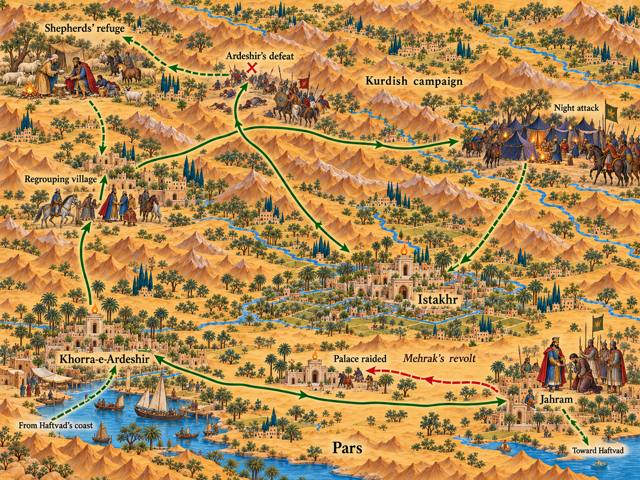
A descendant of Dara, the fourth Sasan, herds Babak’s flocks. Babak dreams of him riding an elephant, then of three fires blazing before him; the interpreters promise kingship to him or his son. Babak learns his lineage, raises him up, and gives him his daughter.
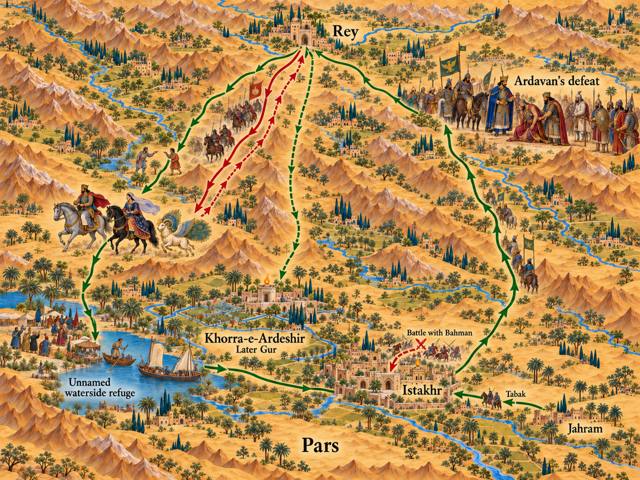
Babak’s grandson Ardeshir is summoned to Ardavan’s court at Rey and treated like a son. On a hunt he shoots a Gur-e-Khar and contradicts the prince who claims the shot. Ardavan banishes him to the stables, where he lives quietly on his grandfather’s gold.
78 couplets · Ardeshir Babakan named 17 times · in the full poem
Nine months had passed; the moon-faced mother’s boyShone like the sun, a radiant birth of joy.
He seemed the image of great Ardeshir,A source of growing joy and constant cheer.
His father looked with wonder on the child,And named him Ardeshir, and gladly smiled.
He reared him fondly, cradled at his breast,And years went by; the boy grew, richly blessed.
Discerning men, whose minds were sharp and clear,Now called the youth “Babakan Ardeshir.”
They taught him every art of hand and mind;These arts enriched the gifts his birth assigned.
In learning, face, and stature, rising high,He seemed a light that set ablaze the sky.
News of his learning reached the royal ear;King Ardavan heard praise of Ardeshir:
“He is a savage lion in the fight,And, feasting, like Nahid in grace and light.”
He wrote to Babak, Pahlevan of fame,And thus addressed the chief of honored name:
“O learned man of pure, discerning mind,A knowing guide, in speech and thought refined,
I hear Ardeshir, your son, is skilled in speech,A horseman quick to learn what others teach.
When you have read this letter, send him here;At once, and gladly, let the youth draw near.
I shall supply his needs and raise his nameAmong the chiefs to dignity and fame.
Among my sons he shall receive his place;I shall embrace him as of royal race.”
When Babak read, red tears ran down his face;Blood from his lashes marked their downward trace.
He summoned both the scribe and Ardeshir,The newly risen youth he held so dear.
He said, “Now read what Ardavan has penned,And weigh each word; let all your wits attend.
I now will send the king a fair reply,Through one I trust beneath the turning sky:
‘Behold, I send a gallant youth to you,My heart and eyes, approved and loyal too.
I have advised him well. When he appears,Receive him royally among your peers.
Let no misfortune touch him in that place;Not even wind should blow upon his face.’”
Then swift as wind he opened treasure’s doors,And gave the youth rich gifts from royal stores:
Gold harness, gorz, and sword he freely gave;He held back nothing that the youth might crave.
Brocade and coins, with slaves, steeds, cloth of gold,And Chinese wares; a royal wealth to hold.
He laid before the youth each precious thing;The youth became a servant of the king.
Babak sent more gifts along with Ardeshir:Gold dinars, musk, and fragrant, sweet abir.
The youth left his grandfather on his way,And rode to Ardavan’s great court at Rey.
They told the king the youth was drawing nearAnd asking leave before him to appear.
He called him in with kindness and good cheer;Of Babak he spoke much for him to hear.
He sat him near the throne, a seat of grace,And in the town arranged his dwelling place.
He sent him food and clothing, every kind,With rugs and spreads for comfort there assigned.
With nobles, Ardeshir then took his wayTo where the king had ordered him to stay.
When sunlight sat upon its throne one day,Earth, white as a Roman face, shone in its ray,
Ardeshir called the envoy to his side,And had the gifts arranged in royal pride.
He sent the gifts to royal Ardavan;The envoy bore them with a Pahlevan.
The king approved the gifts; they brought delight,And raised the youth in favor in his sight.
He held the youth as fondly as a son,And let no care distress him, no, not one.
At wine, at table, or upon the chase,He took the youth along to share his place.
He held him as his kin, in warm affection;His son and Ardeshir shared like protection.
One day, the troops and prince rode out for sport,Then scattered widely, far beyond the court.
Now Ardavan had four sons of his own,In each the signs of royal blood were shown.
Ardeshir stayed beside great Ardavan,Who prized him as a noble of Iran.
A Gur-e-Khar appeared upon the plain;A clamor rose from all the hunting train.
They urged their steeds; the dust rose thick and high,And mingled with the sweat as they sped by.
Ardeshir rode ahead and neared the game,And set an arrow, taking careful aim.
He struck the male Gur-e-Khar’s rump; straight throughIts body went the point and feathers too.
Then Ardavan arrived upon the plain,And saw the fallen Gur-e-Khar lie slain.
He asked, “Whose arrow felled this quarry grand?May life remain united with that hand!”
Then Ardeshir addressed the king to say:“It was my arrow, Shah, that felled this prey.”
One prince replied, “I brought it to its fate,And now I am in search of its own mate.”
Ardeshir answered, “See, the plain is wide;With game and arrows here, let skill decide.
Then strike another with the selfsame art;A lie brings shame upon a noble heart.”
Then Ardavan grew angry with the youth,And roared at him for speaking open truth:
“The fault is mine; I never stand aloof,But nurture those who come beneath my roof.
Why should I keep you always at my side,At feast and hunt, and treat you as my pride,
So you may outshine my own son in skill,And flaunt your strength before him at your will?
Go now and tend my Arab steeds each day;Beside the royal stables you shall stay.
Be master of the stables; ply the tradeOf every groom, and lend the others aid.”
In tears, Ardeshir went to tend the steeds,His heart consumed by grief at Ardavan’s deeds.
“See how I suffer from him, how I smart!May anguish seize his body and his heart.”
He wrote his grandfather, with heart distressed,While schemes and stratagems his mind possessed.
He told the tale of all that had occurred,And why the king to such great wrath was stirred.
When Babak read the letter, he concealedIts news; to no one were its words revealed.
His heart grew dark, weighed down by sorrow’s gloom;He brought out dinars from the treasure room.
Ten thousand dinars for the youth he sent;A rider on a camel with them went.
He called the scribe and bade him ink his reed,And write to Ardeshir with thought and heed:
“O thoughtless youth, still young, recall the dayYou rode with Ardavan to hunt your prey:
Why ride before his son? Your place is clear:A servant of his house, no kinsman here.
He did you no injustice out of spite;Your witless act itself brought on this slight.
Now strive to make him pleased and satisfied;Do all his will and set your pride aside.
I send you gold, and in this letter tooHave set down all the counsel meant for you.
When you have used this sum, ask more to last,And let the passing days go drifting past.”
The old, experienced rider hastened near;His swift camel brought him to Ardeshir.
He read the letter; sorrow gripped his heart,Which turned toward guile and schemes of cunning art.
He chose a lowly lodging by his steeds,Far less than royal birth or honor needs.
With carpets, food, and garments it was dressed,And spreads of every kind were laid for rest.
He passed his days in feasting, wine and song,With strings and minstrels through the whole night long.
Ardavan’s favorite slave Golnar sees Ardeshir from the palace roof and climbs down to him by kamand. Babak dies. Golnar overhears the astrologers predict that a man now held low will flee and become king, and she agrees to escape with Ardeshir, taking jewels from the treasury.
Ardavan brings up his armies; after forty days of fighting a black storm breaks his men’s nerve, and he is captured and cut in two at Ardeshir’s order. Two sons are imprisoned, two flee to Hindustan. Ardeshir marries Ardavan’s daughter and founds Khorra-e-Ardeshir.
At Kojaran a spinning girl finds a worm in an apple and her day’s output doubles. Her father Haftvad grows rich on its luck, seizes the city, and builds a mountain fortress. The worm swells to the bulk of an elephant, and no army that faces it can win.
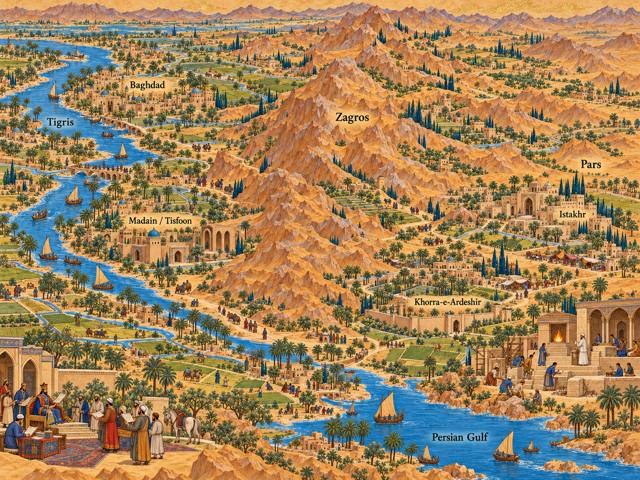
Haftvad storms the fortress and fails. Ardeshir calls Shahrgeer up, and Haftvad and Shahvi are taken, hung on gibbets by the sea and shot dead. Ardeshir gives away the spoil, founds a fire-temple, rewards his two hosts with provinces, and takes the throne at Tisfoon.
Ardeshir takes the ivory throne and is hailed as King of kings. He declares that justice is his only treasure, that no subject shall sleep with a need denied, and that his court is open to friend and foe, then sends armies against the chiefs who resist.
Ferdowsi sets out Ardeshir’s government: recruitment and muster of troops, scribes graded by their pens, charges to governors and generals, care of envoys, relief for ruined districts and impoverished nobles. The king remits the tenth, counsels his nobles on God and conduct, and lays down rules to live by.
210 couplets · Ardeshir Babakan named 5 times · in the full poem
Now hear how Ardeshir, through toil and care,Made justice flourish and the earth grow fair.
Learn too the wise decrees that he decreed,And weigh each counsel for your daily need.
He toiled, and made the rule of virtue stand,And spread both love and law by royal hand.
Desiring more recruits for his command,He sent his agents out through all the land.
They said, “Let none who has a son allowHis youth to grow in ignorance from now.
Teach him the horse, the gorz, the bow in hand,And poplar shafts, as warriors understand.
When trained to strength and proven able too,A youth shall serve beneath the royal view.”
From every realm the youths approached the court,Where muster-masters wrote the due report.
They wrote each name and gave each youth his place,With quarters for the men of martial grace.
When war breaks out, recruits like these shall goBeneath a Pahlevan against the foe.
A learned Mobad shall attend the train,To watch the men upon the battle plain.
One such shall watch a thousand in the fight,And judge what duties suit each warrior’s might.
He notes the coward and the man too frail,And those whose strength and courage do not fail.
He sends the record to the King of kings,With clear report of all such martial things.
The Shah, when he has read the message through,Will seat the messenger before his view.
From treasury’s best he gives a robe of state,To youths whose skill and valor prove them great.
But men unfit shall leave the fighting train,Nor fill the ranks upon the battle plain.
Thus grew his troops so vast beneath the sky,No star could see their bounds from up on high.
The men of counsel rose beneath his hand,Advanced by wisdom serving court and land.
A herald circled through the camp and cried,“You warriors of the Shah in fame and pride:
Whoever seeks the king’s approving sight,And stains the earth with foemen’s blood in fight,
Shall have from me a royal gift and name,And leave memorials bright with lasting fame.”
He ruled the realm through disciplined array,A shepherd guiding armored men each day.
Now see how Ardeshir arranged the bandOf scribes who served the business of the land.
He staffed his public offices with menWhose knowledge matched their mastery of the pen.
He weighed their script, the beauty of each line,And every dot within its fine design.
When skill was duly brought before his eyes,The Shah decreed the writer’s pay should rise.
The lesser scribes served officers instead,Their weaker wit and pen were elsewhere led.
Such men found no employment near the crown;None served there but the penmen of renown.
He knew the practiced scribes among his men,And praised the worthy masters of the pen:
“A scribe who fills the treasury by his art,And lessens toil, sustains the kingdom’s heart.
He aids the state, the army, and the law,And speeds redress without delay or flaw.
The scribes are sinews of my soul and hand,And rule the secrets of my high command.”
When governors went out, the Shah made plain:“Hold money vile throughout your term of reign.
Sell no man’s life for gold; this fleeting stayIs but a lodging all must leave one day.
Seek wisdom, righteousness, and sober view;Let greed and madness keep afar from you.
Take none of kith or kin into your train;The troops I gave will serve you in your reign.
Give monthly gifts to all the poor in need,But not to those who plan a hostile deed.
If justice makes your province prosper too,Then you will prosper by the good you do.
But if a poor man sleeps in fear of you,You sell your soul for silver’s passing hue.”
All those who came to court for state affairs,Or sought redress beneath the royal stairs,
Were met by trusted servants at the gate,Who asked how local governors ruled the state:
“Are they just men, or greedy for reward?Do any wronged lie hidden in their ward?
What learned men are there? Who faints from need?Whose age and counsel best may serve the deed?
What elder, veteran, or pious manCan aid the realm as only wisdom can?”
The King had said, “My toil and treasure’s storeShould serve the learned; I desire no more.
What better thing than one both wise and old,Whose tested words are worthier than gold?
Seek men of long experience, sound and true,And patient youths whose worth is proven too.
For when young men are wise and fit to learn,They take the old men’s places in their turn.”
Whenever his whole army went to fight,He acted with sound judgment and foresight.
He chose a scribe, learned, watchful, wise, and fair,And sent him first as envoy with due care.
He sent a courteous, just appeal ahead,To ward off wrong before men’s blood was shed.
The envoy searched the foeman’s inward mind,To learn what purpose lay in it confined.
If that wise foe perceived his meaning right,And shrank from all the sorrows of the fight,
He gained a robe, a grant, a charter too,A keepsake from the Shah to mark his due.
But if revenge possessed his heart instead,With blood within his liver, wrath his head,
The Shah gave gifts throughout the army band,So no man felt neglected in the land.
He chose a Pahlevan alert and wise,Who sought no rest, with watchful, prudent eyes.
Beside him went a scribe of practiced skill,To check the troops and keep the realm from ill.
An elephant upheld the herald’s frame;For two farsangs his proclamation came.
He cried to all the warriors of the land:“O famous chiefs, renowned in war’s command,
Protect the people all along your road;Let rich and poor rest safe in each abode.
Pay for provisions at each halting stage,And earn the thanks of farmer, youth, and sage.
Let none who worship God take others’ due,Or stain with unjust deeds the good they do.
Whoever shows the foe his back in fightWill see his fortune darkened into night.
His grave will stand nearby, or iron chainWill gall his neck and breast with bitter pain.
Or else, dismissed, on dust he shall be fed,And darkened dust shall be his only bed.”
Then he would charge the captain of the men,“Be neither slack nor rash in danger then.
Keep elephants in front; push scouts ahead,Full four farsangs before the army’s tread.
When battle comes, move through the troops, and hailEach rank: ‘Remember who you are, nor quail.
Remember why you stand upon this field;Let no man’s courage break, retreat, or yield.
For every one of you I shall obtainA robe from Ardeshir for this campaign.
A hundred hostile horsemen against oneOf ours are few, when battle is begun.’
When any horsemen advance on either side,Let not the center stand deserted, wide.
However vast the army you command,An empty center puts it in death’s hand.
Set your left flank against the foeman’s right,So matched opposing forces meet in fight.
Set right against their left across the plain;Let every mind attend the baggage train.
No man within the center shall advanceA single foot by haste or random chance.
But if the opposing center moves ahead,Then move your own where ordered ranks are spread.
When you have triumphed, shed no fleeing blood;Let mercy check the battle’s crimson flood.
If beaten foes ask quarter, grant it then;Be not revengeful toward defeated men.
When you observe the foe begin retreat,Seek not the spoil, nor leave your ordered seat.
Beware of ambush still on vale and plain;Do not deem all secure and quit your train.
But once assured, heed no distracting word;Stand by the judgment you have made and heard.
Bestow the spoil on those who sought the fray,And washed from hearts the love of life away.
Bring every captive taken on that dayBefore my court, without excuse or stay.
I shall build there where thorn and bramble growA city where the captives all may go.
As you would live at peace, secure, and sound,Do not reject the counsel you have found.
And in your triumphs always bend to God,Because His guidance marks the path you trod.”
When envoys came from Turks or Romans bold,Or noble peoples, this command was told:
The border chiefs must know when envoys came,And let no negligence disgrace their name.
Along the road let lodgings be made ready,With care for every envoy, sure and steady.
Such was the charge appointed through the land:Food, robes, and carpets furnished at command.
Along the route they learned the envoy’s aim,His business, country, mission, rank, and name.
A noble camel bore a scribe, who pressedAhead to tell the Shah the guest’s request.
The troops rode out to meet him on the road;The victor Shah, enthroned, his splendor showed.
On either side attendants took their stand,In robes with gold embroidered, bright and grand.
He called the envoy near, with honor treated,And by the royal throne he had him seated.
He asked his business, hidden, plain, his name,The good and bad, his standing and his fame,
Of justice and injustice, what he knew,His land, its customs, king, and army too.
He led him to a palace set apart,And furnished it with all befitting art.
He held a feast with wine in royal state,And by the golden throne the envoy ate.
He took him hunting with a mighty train,A countless force of riders on the plain.
He sent him off with ceremonial care,And gave a royal robe for him to wear.
He sent wise Mobadan through every town,Men kind and shrewd, commissioned by the crown.
They raised new cities, spacious, sound, and bright,With royal treasure spent to build them right.
Each homeless man whom fortune left in need,Whose poverty gave grief a place to breed,
Received both food and shelter at command;Thus grew the people subject to his hand.
His name is current now as it was then,In public speech and private hearts of men.
One monarch only in the world we findWho brings lost Ardeshir again to mind.
I bring his name to life in words that last,And call his memory from the distant past.
How wondrous was the justice of his reign!Prosperity became his rightful gain.
The Shah received reports from far and wide,His agents learned what every place might hide.
Whenever men of wealth fell in distress,His agents learned, and brought it for redress.
He raised their fallen fortunes, made them thrive,And caused their ruined markets to revive.
He gave them fertile lands and houses too,With slaves and servants for each household due.
He gave this aid in secret, keeping allUnknown to those within the city wall.
If talent showed in children of their line,He gave them teachers who could make it shine.
In every quarter halls of learning stood,Beside the fire-temples, strong and good.
He let none want, save one who chose to maskHis poverty, and never came to ask.
He judged the subject and his own dear son,As though the two before him stood as one.
His justice made the whole world bloom and grow,And all his subjects’ hearts were set aglow.
When any king with justice is allied,In spite of time his footprints will abide.
Observe the policies of that brave chief,Whose every act brought suffering relief.
His watchful agents, wise in every land,Went through the world according to command.
Where any country bore too great a weightOf tax, through failing streams or ruined state,
He lifted taxes from the ruined ground,And mercy reached the smallest holdings found.
If any landholder was losing all,The Shah supplied his need before the fall.
From treasury he gave them cattle too,And tools, to keep their holdings firm and true.
Now hear, O king, the sayings of this sage,And make the world as bright as in his age.
If you would live in peace and free from pain,And heap no wealth through wrongful loss or gain,
Seek that your subjects live in quiet too,And win the praise that is your rightful due.
From Rum and Chin to Hind and Turan’s lands,The world grew Roman silk beneath his hands.
Both toll and tax flowed in without delay;No land defied him; all would now obey.
He called Iran’s nobility to meet,And gave each nobleman a royal seat.
Then rose and spoke with majesty and grace,And gave this royal counsel in that place:
“O chieftains, wise in counsel, hear and learnHow turning heaven deals, now kind, now stern.
It does not heed our justice, love, or hate,But raises whom it will, then shifts his fate.
It sets one man upon the height of all,Then gives him dust and sorrow at his fall.
His name alone survives beneath the sky;His toil lies buried where his ashes lie.
Then strive to leave a name of goodness here;No other lasting gain shall grace your bier.
Your lot, O Hormizd, rests in God’s decree;As He approves, so shall your portion be.
Commit yourself to God in all you do;He is Yazdan who makes good grow for you.
From every ill seek shelter in His might;Both good and bad lie in His ruling right.
He makes all hardship easy on your way,With brightened counsel and victorious day.
Judge by my life; consider and reviewThe good and evil I have journeyed through.
When I turned to Yazdan, Lord over all,My heart rejoiced in crown and palace hall.
I rule the seven climes, for God deemed rightThat I should hold them by His sovereign might.
From Rum and Hind I take the tribute due;The world grew Roman silk beneath my view.
Thanks be to God, who gave me strength and star,And favor from the sun and Saturn far.
Who knows how rightly we should praise His name,Or serve Him as His greatness would proclaim?
May He grant us the strength to serve His cause,And show His greatness and His sovereign laws.
And now I tell the just acts I intend,That joy and justice through the realm may blend.
Though one-tenth from communities is mine,As dehqan and the Mobad both define,
I ask it not; I give it back to you,The tax on land and flocks that once was due.
If any surplus from your toil was gained,It is restored; let no man be constrained.
The tithes and taxes that I took before,Whatever came to me, be it less or more,
I used them for your good throughout the land,And kept a countless army at command.
I sought your greatness, safety in your need,And to diminish Ahriman’s dark creed.
Hold fast to God, be diligent each day,And never cast His covenant away.
He gives, sustains, and feeds the low and high,The Maker of the overarching sky.
He shelters the oppressed beneath His care;Let no vain boast possess you anywhere.
Let no deceit take lodging in your breast;Descent will follow on the highest crest.
Where are the men whose crowns once brushed the clouds?Where are the lion-hunters and their crowds?
They all lie couched on dust and brick below;Blessed is the man whose seeds of goodness grow.
Let all who dwell within my realm give ear,And take to heart the counsel spoken here.
Five paths I show, of greater worth to holdThan crowns and treasure, sovereignty and gold.”
Now listen, all who serve, and hear againThe words of Ardeshir to all his men.
“First, know that God exists, and keep His ways;With pure devotion offer Him your praise.
Second, despise not knowledge, whether youAre subject, lord, or servant proven true.
Third, words of wisdom never can grow oldFor learned minds, however often told.
Fourth, fear the guilt of sin, whose threats are moreThan royal bonds or any prison door.
Fifth, know the slanderer, whatever his claim,Can never win the people’s good acclaim.
One further counsel: prize above your treasure,Your eyes, your life, this word beyond all measure.
Blessed is he whose deeds in public viewMatch those in private, constant, just, and true.
Soft-spoken, modest, wise, and cordial still,Let warm and kindly words express your will.
Who squanders silver for a boastful show,And spends to make his empty splendor grow,
Finds none to thank him for that vain display;The man who knows God turns from such a way.
Hold to the middle course and keep your place;Pure judgment wins the wise man’s name and grace.
Five further paths will set your faith upright,And make the course of conduct clear and bright.
They bring the heart both comfort and delight,Like honey free of poison’s harmful bite.
First, do not overreach through greed or pain;Accept what God has set for loss or gain.
The man content is rich in everything,With fruit and blossoms like the days of spring.
Next, break the neck of greed; let no one hearYour secret words when women’s ears are near.
Third, do not court the path of war and strife,For toil and anguish follow through your life.
Fourth, bar all grief from entering your breast;Let future evils not disturb your rest.
Fifth, shun affairs that fall beyond your claim;They are no quarry for your thought or aim.
Hear now my counsel, weigh the words I say;Their profit shall attend you on your way.
Cease not from learning if your mind would burn;The mind is kindled by the truths you learn.
If you have children, teach them, and curtailTheir play, so that their wisdom may prevail.
Attend my words and pains endured for you;I bear them so your judgment may stay true.
Let just and shrewd hearts not dissolve their ties;Preserve the fellowship that makes men wise.
Seek peace of heart through four enduring ways;Each brings you profit through the length of days.
First, fear and honor God with heart and mind,That He, your Help and Guide, may stand behind.
Next, act with justice toward yourself, and keepYour garment’s hem from stains that settle deep.
Take God’s commands to heart, and let me claimThe love you bear your own dear living frame.
Third, make the right stand plain before all eyes;Cast fraud away, and ban deceit and lies.
Fourth, never from the Shah’s command depart,In open deed or secrets of your heart.
Love him as your own self, and in his sightObey his word, and let your face grow bright.
Let loyalty possess your inmost soul;Keep covenant and let his word control.
Love him as life, if he is just and true,And stands a faithful guardian over you.
The Shah must bear the burdens of command,And seek the good and welfare of the land.
If he knows frontier lords or troops oppressThe realm, and leaves the people in distress,
Yet grants no justice, he is king no more,Nor worthy of the royal crown he wore.
He tears the sacred charter of command;The farr departs from his unrighteous hand.
An unjust king, a lion, stalks and preysAcross the pasture where the helpless graze.
Who treats the Shah’s command with heedless scorn,And fails in diligent toil, shall live forlorn.
His life is pain and toil upon the road;He will not reach old age in this abode.
If goodness and true greatness are your need,They spring from neither pride nor miser’s greed.
May all my subjects’ hearts rejoice and flourish;May my just rule the whole world bless and nourish.”
At seventy-eight and failing, Ardeshir charges Shapur: faith and kingship are twin brothers, treasure and anger are traps, slander and confidences are to be shunned. He foretells that his house will break the covenant and fall, lists the six cities he founded, and dies.
 New Naqqali