Ten nights of dreams frighten Kayd of Hind, and none of his sages can read them. The hermit Mehran interprets each as a sign of a corrupt age to come, and advises Kayd to buy off the approaching Iskandar with four treasures no other king possesses.
1 A teller of the tales preserved of old Now brings a wonder worthy to be told.
2 There once ruled Kayd, a king of Hind renowned, Whom wisdom, insight, happiness had crowned.
3 A sage at heart, his mind a chieftain’s own, With Mobad’s glory on Kayanian throne.
4 For ten long nights strange dreams disturbed his bed; Each heavy omen filled his heart with dread.
5 The wisest men of Hindustan combined, To learn what future these strange signs outlined.
6 The counselors and sages met the call, To hear the dreams recounted in the hall.
7 The king laid every dream before the wise, And brought to light the secrets they disguise.
8 Not one could tell what any dream foretold; Their faces paled, their hearts with worry cold.
9 Then spoke a sage: “O master of the state, Heir to the wisdom of the good and great,
10 There is a famous one, Mehran by name, Who has attained the height of lettered fame.
11 He will not sleep or rest within a town, Among wild creatures he must settle down.
12 He feeds on seeds the mountain plants provide, And lives with beasts upon the mountainside.
13 He does not count us as his fellow men, Nor seek our company in field or glen.
14 His home is with wild sheep and deer that roam, Beyond men’s power to harm him in his home.
15 No harm can touch him in his lonely state; Devout is he and blessed by lofty fate.”
16 The monarch said: “We must not pass him by, A holy man whom Heaven holds so high.”
17 Moved by the hermit’s fame, the king arose, And mounted on the finest steed he chose.
18 His scholars followed in a noble train, To soothe his troubled heart and ease its pain.
19 The Shah approached the mountain where he dwelt, And greeted him with courtesy heartfelt:
20 “O worshipper of God, who makes his home Upon the heights where sheep in freedom roam,
21 Attend these dreams, consider every one, And tell their meanings when my tale is done.
22 Know that one night, within my chamber deep, I laid my limbs to rest in peaceful sleep.
23 A vast house rose; no door appeared in sight, Where stood a giant elephant of might.
24 It found a narrow opening in the wall, And passed out safely from the palace hall.
25 Its massive bulk went through the straitened space, Yet left its trunk behind within the place.
26 Next night I saw the royal seat and found It bare of anyone by fortune crowned.
27 Another king then took that throne of white, And set upon his head a crown of light.
28 The third night, sleep came swiftly, and I dreamed Of finely woven cloth whose surface gleamed.
29 Four men hung on the cloth and strained and drew; Their faces from the pulling turned dark blue.
30 Not one grew weary, though they pulled and bent; The cloth held fast and whole, without a rent.
31 Upon the fourth, O sage of holy grace, I saw a thirsty man in some wild place.
32 Beside a stream he stood with thirst and dread, While fish poured water down upon his head.
33 He fled the water, springing far and wide; The stream pursued him, running at his side.
34 The fifth night brought a city near a stream, Whose people all were sightless in my dream.
35 Yet none showed anger at his blinded eyes, Nor let his sightless state give wrath its rise.
36 The city thrived on justice, gifts, and trade, And glowed with all the splendor these had made.
37 The sixth night showed a city full of grief, Whose people all were sick and lacked relief.
38 The sick would call upon the healthy, bent To tend them first, on thoughtful care intent.
39 Though near to death, they asked, ‘What pains you so?’ And sought a cure for suffering and woe.
40 Halfway through night the seventh vision spread: A leaping horse appeared with double head.
41 Two forelegs and two hind legs bore its frame; Each mouth consumed the grass, its fare the same.
42 It cropped the grass on both sides with its teeth, Yet had no outlet anywhere beneath.
43 The eighth night showed three jars set in a row; Hear now the marvel those three jars would show.
44 The outer two were brimming to the top; The central one was dry without a drop.
45 Two good men poured cold water, bright and clear, Into the middle jar that stood so near.
46 The outer jars lost nothing of their store; The middle stayed as dry as long before.
47 The ninth night showed a cow beside a stream, On grass beneath the sun within my dream.
48 A gaunt and wizened calf stood there to feed Its mother, who drew milk for each day’s need.
49 The mother cow was strong, her body great; The little calf was in a feeble state.
50 Now hear the tenth; be patient while I tell This final dream and all that there befell:
51 A spring lay in a plain of ample spread, With lofty halls and a palace overhead.
52 Its waters reached the lands on every side, Yet in my dream the source itself was dried.
53 Reveal the future, tell me what it means, And tear the veil that hides these shifting scenes.”
54 Mehran replied: “Dismiss your heavy fear; No ruin shall approach your kingdom here.
55 Iskandar comes with legions in his train, And chiefs of Rum and of the Iranian plain.
56 If you would keep your honor whole and bright, Use wisdom; do not challenge him in fight.
57 Four unique treasures rest within your hand, Whose equals are unknown in any land:
58 Your daughter first, a maiden fair and wise, Whose beauty shines like light from paradise;
59 Your hidden sage, whose learning can impart The secrets of the world to every heart;
60 Your famed physician, learned in healing lore, Whose knowledge wins him honor more and more;
61 And fourth, a cup whose water knows no heat From fire or sun, however fierce they beat.
62 Its water never lessens as you drink; Through these four gifts, your honor need not sink.
63 When Caesar comes, yield all four to his hand, And he will turn away and spare your land.
64 His troops and means of war surpass your own; You cannot match the splendor of his throne.
65 Now hear good counsel, cast away your fear; The meaning of each dream I shall make clear:
66 That house denotes the world; the beast you saw Denotes a thankless king who scorns the law.
67 His crooked speech and deeds put right to shame; Apart from wrong, he bears but kingship’s name.
68 The second showed your throne and crown made bright, When fortune brought another king to sight.
69 Such is the world: the power one calls his own Will pass away; another takes the throne.
70 His heart is base, his body weak and worn, His spirit dark, by greed and craving torn.
71 His subjects flourish, while his heart knows grief; His lips make empty boasts beyond belief.
72 The third dream showed the cloth without a rent; Four men kept pulling yet were never spent.
73 That cloth is God’s religion, firmly spread; Its four opposing pullers hold each thread.
74 The first, the dehqan, tends the sacred fire, And holds the sacred twigs his rites require.
75 The next is Moses’ faith, the Jewish creed, Which holds itself the only faith to heed.
76 The third, the pious Greek’s religious art, Puts thoughts of justice in a monarch’s heart.
77 The fourth, Arabian, pure in heart and hand, Shall raise the wise and prudent through the land.
78 These four shall pull the cloth in separate ways, And fight for their religions all their days.
79 Then from the plain where mounted lancers ride, A man shall come, with goodness as his guide:
80 A pure and kindly man, who comes to lead, Shall spread four ways across the earth God’s creed.
81 The thirsty man who fled the river’s side, While fish poured water on him from the tide,
82 Foretells a time when learning meets disdain: A pure man drinks, but others still abstain.
83 Like fish within the sea, he stays below; The wicked rise where the Pleiades glow.
84 He calls the thirsty; none will heed his plea, Or turn toward learning’s water, offered free.
85 They flee the man of knowledge and proclaim Their slanders in a crowd against his name.
86 The fifth dream showed a city, blind and bright, With trade and gifts that made it glow with light.
87 Yet none could see another’s face or form; Such blindness shall become the age’s norm.
88 It tells of times when wise men shall be slaves, Subjected to the rule of fools and knaves.
89 The learned shall be troubled in that hour; Their tree of wisdom bears no fruit or flower.
90 The ignorant shall hold the highest seat, While lettered men must flatter at their feet.
91 False words are spoken, known to be untrue; No light of worship shines on what they do.
92 The sixth showed sick men serving those still well, Foretelling times whose hardships I shall tell,
93 When poverty is scorned and wealth is prized, And poor men by the rich are all despised.
94 The rich shall turn away from those who sue, And give no alms where charity is due.
95 The poor man serves for nothing, bound to stay, A slave for whom no purchaser need pay.
96 The horse with two heads grazing on the plain, Yet no way out for all its gathered gain,
97 Foretells a time when men shall hoard their store, And never fill their hearts, but long for more.
98 Their stores give poor men, sages, chiefs no aid; For none but self is any care displayed.
99 The three jars, with the middle standing dry, Though water from the others poured nearby,
100 Foretell an age when poverty knows shame, And bitter sorrow sets the heart aflame.
101 The spring cloud hides the sun yet gives no rain To soothe the poor man’s wounds or ease his pain.
102 The rich give to the rich with honeyed praise; Their gifts pass back and forth through all their days.
103 The poor man’s lips stay dry through every day, And through the night no comfort comes his way.
104 The cow that drank her calf’s milk in your sight, Though she was strong and he was weak and slight,
105 Shows Saturn entering Libra in the sky, While power of arm rules all the world thereby.
106 The sick and poor and needy, day by day, Must give the healthy what they bid them pay.
107 The wealthy will not open up their stores, But turn the suffering poor from their doors.
108 The tenth dream, where the fountain-head was dry, With musk-sweet waters spread about nearby,
109 Showed no fresh water rising to its flow; Its waters had no haste, but lingered slow.
110 It tells of one who wears a crown of care, Bereft of wisdom, darkened by despair.
111 His troubles darken earth from shore to shore; The land lies empty of his treasured store.
112 He raises armies, rank on rank arrayed, To shape a crown and see the realm obeyed.
113 Both king and troops shall fall; new courts arise, While evil costs him favor from the skies.
114 But our great epoch is Iskandar’s hour, Who holds the crown of majesty and power.
115 When Caesar comes, give up those treasures four, And he will leave your land and seek no more.
116 Content him, and he passes on his way, For wisdom guides him; he will not delay.
117 Among the sages none has depths so great; His counsel serves in every work of state.”
118 King Kayd rejoiced at all the sage had said, And felt new life throughout his spirit spread.
119 He kissed the scholar’s eyes and holy head, And turned for home, his heart relieved of dread.
120 He journeyed home with peace restored to mind; His scholars followed, leaving grief behind.
 New Naqqali
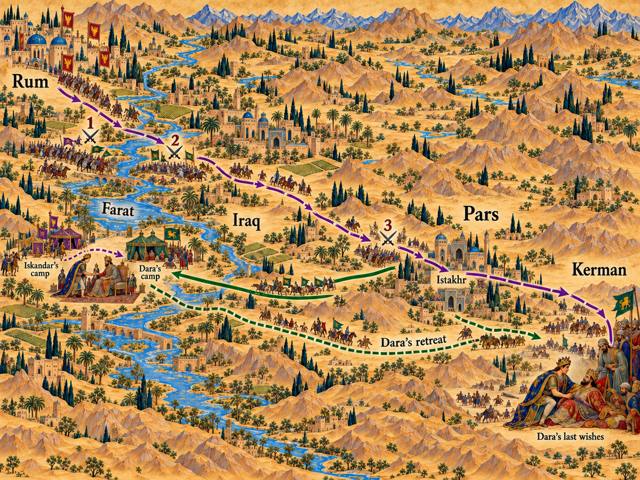 D4.3–D4.9The War of Dara and Iskandar
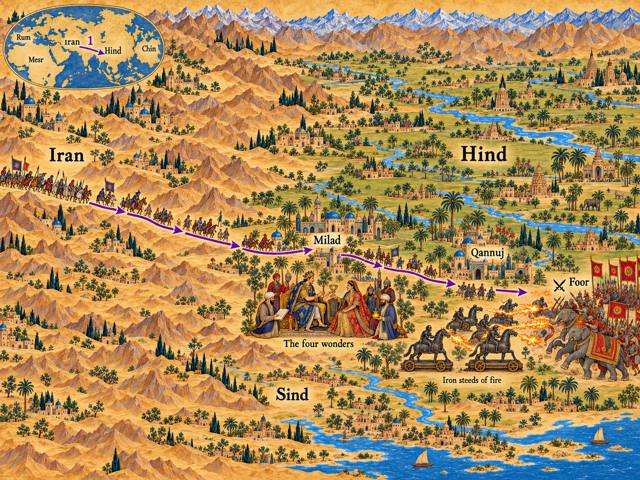 D5.5–D5.15Iskandar into Hind: Kayd and Foor
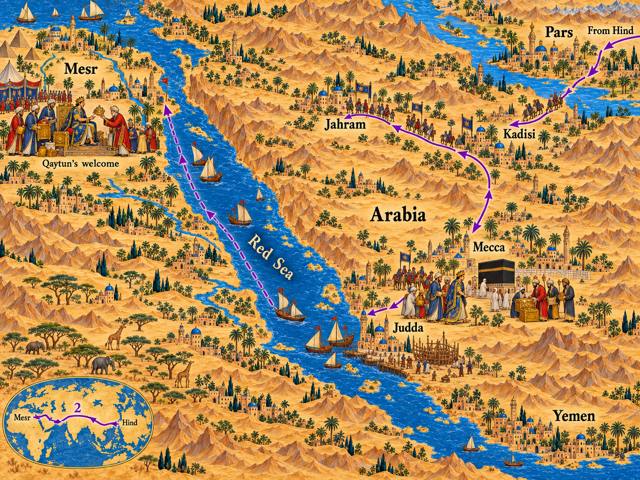 D5.16–D5.17The Pilgrimage West: Mecca, Judda, and Mesr
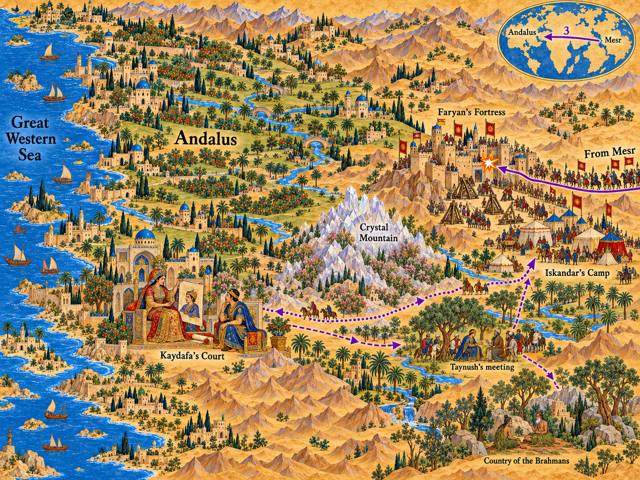 D5.18–D5.24Andalus and Queen Kaydafa
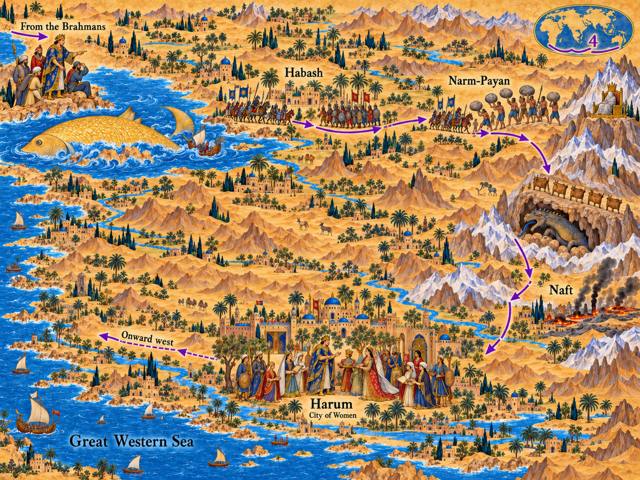 D5.25–D5.28The Marvels of the South
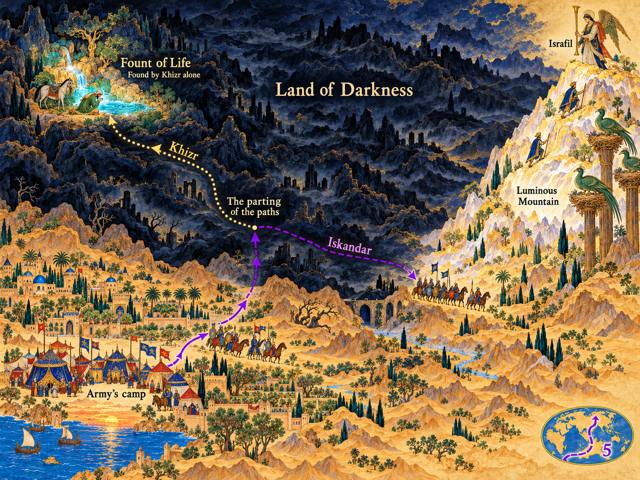 D5.29The Land of Darkness and the Fount of Life
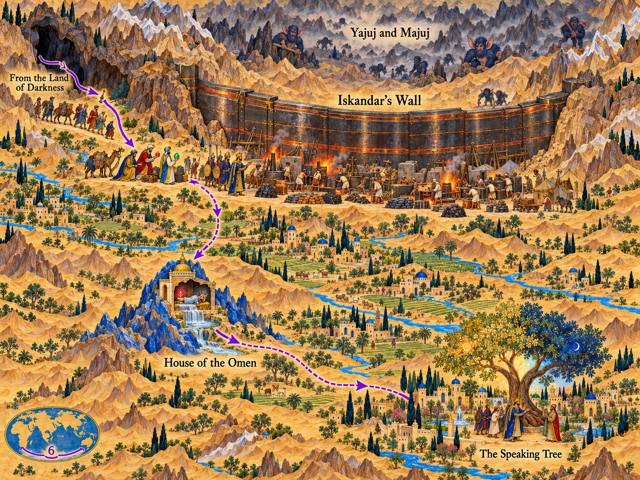 D5.30–D5.31The Wall against Yajuj and Majuj
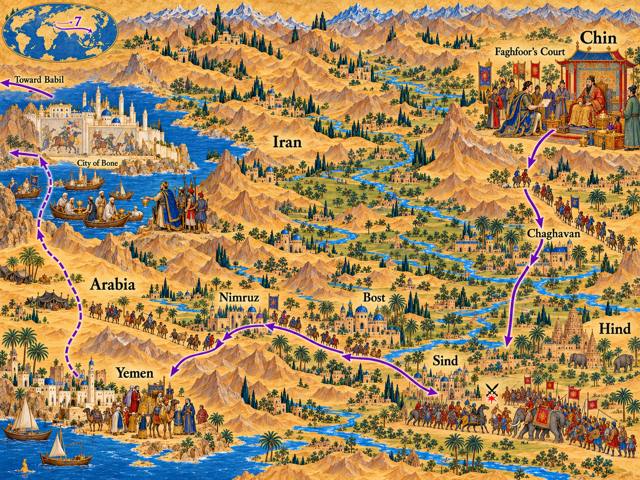 D5.32–D5.34The Eastern Return: Chin, Sind, and the Treasure