 New Naqqali
Shah of Iran · the Pishdadian line
Jamshidجمشید
jam-SHEED
The fourth king, whose glory ended in pride; he was sawn in two by Zahhak.
His story, in the poem’s own sections
2 sections, with the summary from the Notes. Open any one to read it in full here; tap a couplet number to cite it or suggest a better one.
A4.1
The Greatness and Fall of Jamshid
👑⚒️🏛️💎🎉😤✨📉8 emoji · the whole poem in emoji →
Jamshid forges arms, weaves cloth, orders society into four classes, sets the Divs to building, and flies through the air on a jeweled throne on the first Nowruz. After three centuries without death, pride leads him to claim he is the World-Creator, and his farr departs.
76 couplets · Jamshid named 6 times · in the full poem
Jamshid, the son of Tahmuras the wise,Took up the crown that reached toward the skies.
With all his father’s teachings firmly known,He rose and claimed the crown, the realm his own.
He wore the diadem of shining gold,And ruled with glory like the kings of old.
He girded on the royal farr as guide,And all the world obeyed him far and wide.
Contention ceased, and rest came over all;Div, bird, and pari answered to his call.
The world grew bright beneath his sovereign hand,And splendor spread throughout the glorious land.
“With divine farr, both Shah and Mobad I;In me the crown and sacred office lie.
The wicked from their evil course I turn,And lead all souls toward light for which they yearn.”
He forged the arms that warriors must wield,And opened wide the gate of honor’s field.
With farr he made the stubborn iron flow,And forged its strength to meet the coming foe.
He made the helmet, jowshan, cuirass bright,And quilted armor for the press of fight.
He forged the sword and barding for the steed,And every arm a warrior might need.
His eager mind brought every art to flower,For fifty years he labored, hour by hour.
Then fifty more he gave to cloth and thread,To clothe mankind for banquet, field, and bed.
From linen, silk, and wool the thread was spun,Fine cloth and costly fabrics were begun.
He taught men spinning, twisting strands to twine,And weaving warp with weft to fabrics fine.
Then woven cloth was washed and sewn with skill,And men learned every craft at Jamshid’s will.
Then, for mankind, he set in ordered placeThe four great orders of the human race.
He summoned craftsmen forth to fill this space,And spent another fifty years apace.
The first, the Katozians, served in prayer;Apart from other men, devout in care.
Upon the mountains he ordained their ways,That worship might alone command their days.
They bowed before the radiant Lord of all,And made His worship their enduring call.
The second rank the Nisarians were named,The lion-hearted warriors, battle-famed.
They peopled all the armies far and wide,The shield of kingdoms, and the nation’s pride.
Through them the royal throne remained secure,And through their deeds the warrior’s name endured.
The third, the Nasudi, tilled the ground;They sowed and reaped where ripened grain was found.
They ate the bread their own hands brought from soil,And heard no man reproach their honest toil.
Though ragged-clad, no master’s word obeyed,As free men on their given fields they stayed.
Their bodies free, the world through them was fed;No judge or quarrel troubled where they tread.
The sages said; and heed the words they gave:“Through sloth, a free man makes himself a slave.”
The fourth, Ahtukhushi, worked by hand,The craftsmen serving needs throughout the land.
Their craft was labor; thought was never still,Their restless minds grew sharper through their skill.
Thus Jamshid spent full fifty years in toil,Till all men found their place upon the soil.
For every order he assigned its place,That each might know his measure and his space.
He bade the Divs reshape the earth with skill,And mix the clay with water at his will.
They learned which forms could rise from tempered clay,And molded bricks to build without delay.
With stone and lime the Divs raised walls upright,And works of measured building came to light.
They raised great baths and palaces on high,And sheltering eyvans opened to the sky.
He searched the mountains for their hidden store,And sought bright gems within the stubborn ore.
Ruby and garnet, silver, shining gold;The mountain yielded treasures from its hold.
By magic from the hard stone these he drew,And opened hidden bonds no craftsman knew.
Then fragrant things he taught mankind to brew,The scents whose sweetness men would long pursue.
He brought forth camphor, bān, and fragrant musk,Aloeswood and ambergris from dusk;
He brought forth medicine for every pain,And showed how health might overcome its bane.
The secrets of good health he brought to light;No seeker ever reached so great a height.
Then over water he by ship would fare,From land to land he hastened everywhere.
For fifty years he labored over art;No craft stayed closed to wisdom’s searching heart.
When all these works were brought to fitting place,He raised his step beyond his former space.
He built a throne with jewels richly set,The like of which no eye had witnessed yet.
When he commanded, Divs bore it on high,And raised it from the plain toward the sky.
There sat the Shah, like sunlight in the air,While all the world gazed up in wondering stare.
The world assembled round his jeweled throne,Astonished by the farr that round him shone.
On Jamshid gems were scattered in a spray,And they named Nowruz for that newborn day.
On Ormozd day, when Farvardin began,The New Year opened for the world of man.
The body rested then from toil and pain,The heart found rest from rancor and disdain.
The chiefs rejoiced and raised the cup with wine,While harp and song proclaimed the feast divine.
That blessed feast remained from ancient kings,A royal memory that each Nowruz brings.
For three full centuries their fortune shone;Throughout the world, death’s shadow was unknown.
No pain or evil marred the lives of men;The girded Divs obeyed their bidding then.
They bent their ears to every human word,And songs of joy throughout the world were heard.
So years went by beneath his royal farr;The world saw only good beneath his star.
At last, from his high throne, he gazed about,And saw himself alone the world throughout.
Though knowing God, the Shah succumbed to pride;He turned from God and cast all thanks aside.
He summoned all the great men of his train,And spoke these words, grown arrogant and vain:
“I know no other sovereign on this earth;All arts that grace the world from me had birth.
I made the world as fair as you behold;It took the very shape my will foretold.
Your food and sleep and rest all come through me;Your labor, pleasure, clothing; all you see.
The royal crown and greatness all are mine;Who dares proclaim another king’s design?
Through medicine I made the sick arise;Through me death lost its terror in your eyes.
Your life and reason in your bodies cameThrough me; who doubts me bears Ahriman’s name.
If you acknowledge all these deeds as mine,Then call me World-Creator by design.”
Mobadan bowed; no answer could be heard;Then divine farr withdrew at Jamshid’s word.
For twenty-three full years his court declined,His troops dispersed, his champions left behind.
The wise have said: “When kingship comes to you,Serve God, and let your gratitude stay true.”
Dark grew the day for Jamshid in his fear;His world-bright farr began to disappear.
He wept blood-tears and begged his Maker’s grace;His farr still waned; dread darkened every place.
A4.4
Fortune Flies from Jamshid
Iran falls into disorder, and its chiefs go over to the Arab king Zahhak, who takes Jamshid’s throne. Jamshid hides for a century, is caught by the Sea of Chin, and is sawn in two. The poet reflects on the world’s treachery.
27 couplets · Jamshid named 7 times · in the full poem
Then uproar rose through Iran far and wide,And war broke out on every troubled side.
The bright day darkened over Jamshid’s reign,And men broke faith with him throughout the plain.
His farr grew dark and slowly slipped away,As crookedness and folly marked his way.
On every side a claimant sought the crown;Each raised an army, casting Jamshid down.
From Iran, troop on troop took up the roadToward Arab lands to seek a king’s abode.
They heard that one in Arab lands was king,A dragon-visaged, dread, and savage thing.
So all the restless chiefs and riders boldWent forth to Zahhak, as the tales have told;
They bowed before him, pledging their accord,And hailed him king, their sovereign and their lord.
The dragon-visaged king came sweeping on,And crowned himself as Jamshid’s strength was gone.
He gathered troops from every distant side,Iran and Arab forces stood allied.
His march assailed the throne that Jamshid held,And all his waning fortune was dispelled.
Hard-pressed by Zahhak, Jamshid turned and fled,And left the throne for Zahhak’s rule instead.
His crown, his throne, his diadem and gold,His army too; he left all he controlled.
The world went dark; Jamshid withdrew from sight,And lived concealed, a fugitive in flight.
A hundred years he lingered thus concealed,His fate by time and shifting fortune sealed.
But in the hundredth year he came in viewBeside the Sea of Chin, where he withdrew.
Zahhak seized Jamshid, granting no delay,And sawed him end to end in halves that day.
Long from the dragon’s breath he kept concealed,Yet in the end his refuge was revealed.
Time drew his crown and throne from him like strawDrawn hard to amber by its hidden law.
What king was ever greater in his reign?But what remained from all his toil and pain?
For seven hundred years his reign held fast,With good and evil mingled till the last.
Why seek long life within this world of change,Whose hidden ways no mortal mind can range?
It feeds you honey, sweetness without end,And speaks so gently, seeming like a friend.
You think its heart has turned to you alone,And pride yourself on the love it has shown.
You trust the world and open all your heart,Confiding every secret, every part.
Then suddenly its treachery is plain,And fills your heart with blood and bitter pain.
My heart is weary of this passing place;O God, release me from its harsh embrace.
Family
- Parents
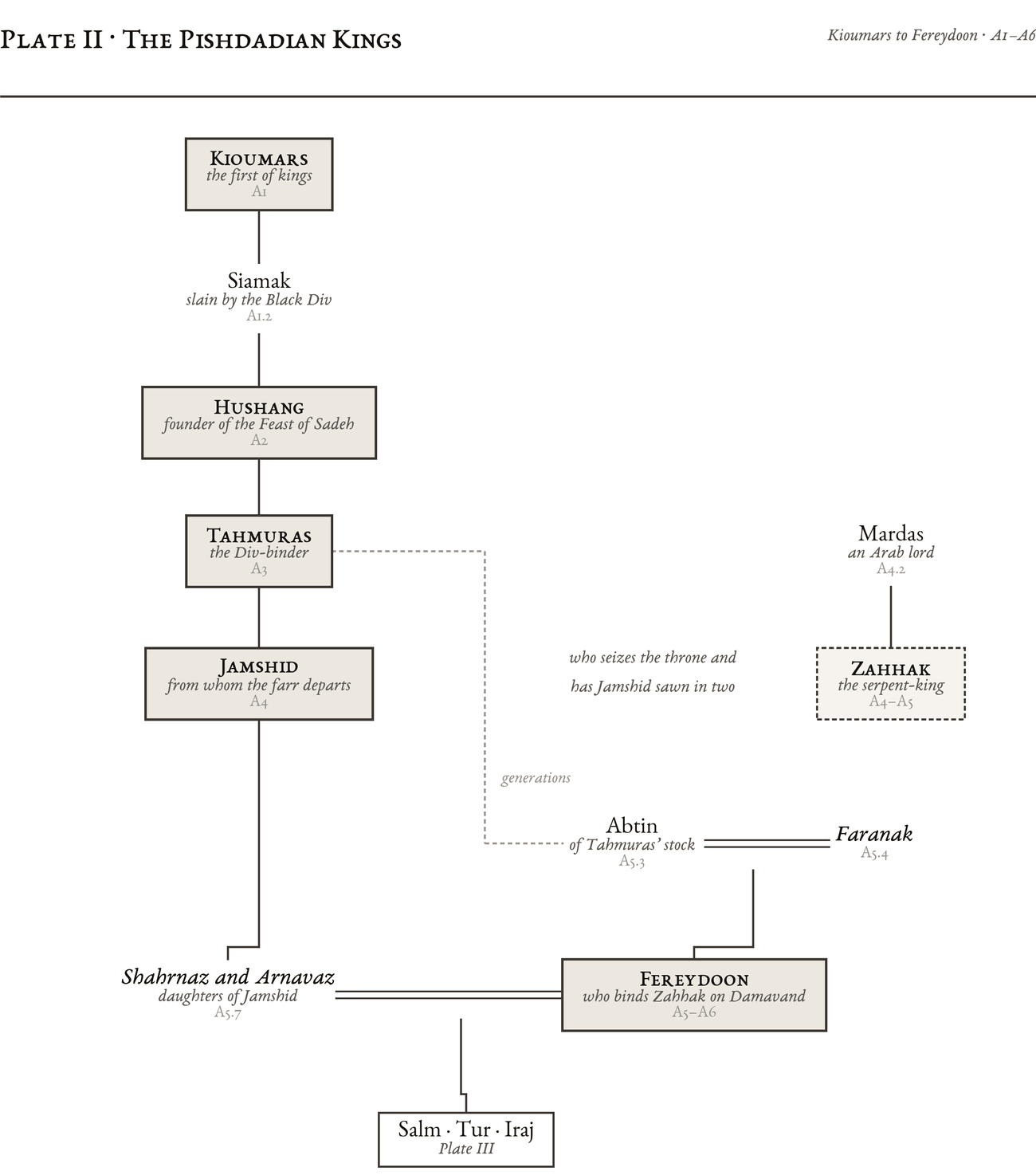
- Tahmuras
- Children
- Shahrnaz, Arnavaz
Where he appears
Named mentions by book, from the Universe Registry. Titles such as “the Shah” and epithets are not counted.
A4The First Kings: Jamshid and the Rise of Zahhak13A5Zahhak’s Tyranny and the Uprising of Kaveh6A6The First Kings: Fereydoon4B4The War with Mazandaran3B8The Tragedy of Rostam & Sohrab1B9The Story of Siavash1B10Vengeance for Siavash and the Retrieval of Kay Khosrow1B12Forood and the Snowstorm Campaign1B14The Great Battle with the Khan of Chin1C3The Battle of the Twelve Rukhs1C4The Final Afrasiab Wars and the Disappearance of Kay Khosrow9C6Goshtasb, Zardosht, and the War with Arjasp4C8The Tragedy of Rostam and Esfandiyar4C9Rostam and Shaghad1D1The Reign of Bahman, Son of Esfandiyar1D4Dara and Iskandar1D5The Iskandar Cycle1D6The Ashkanian Dynasty1D7The Early Sasanians1D10The Bahram Goor Cycle: Justice, Foreign Adventures, and End of a Reign8D11Short Reigns and a Crisis with Khoshnavaz2D12Qobad and the Mazdakite Revolution1E3Bozorgmehr’s Fall and Restoration1E6Khosrow Parviz5E8Shiruyeh’s Coup and the End of the Great Reign1E10Yazdegard1