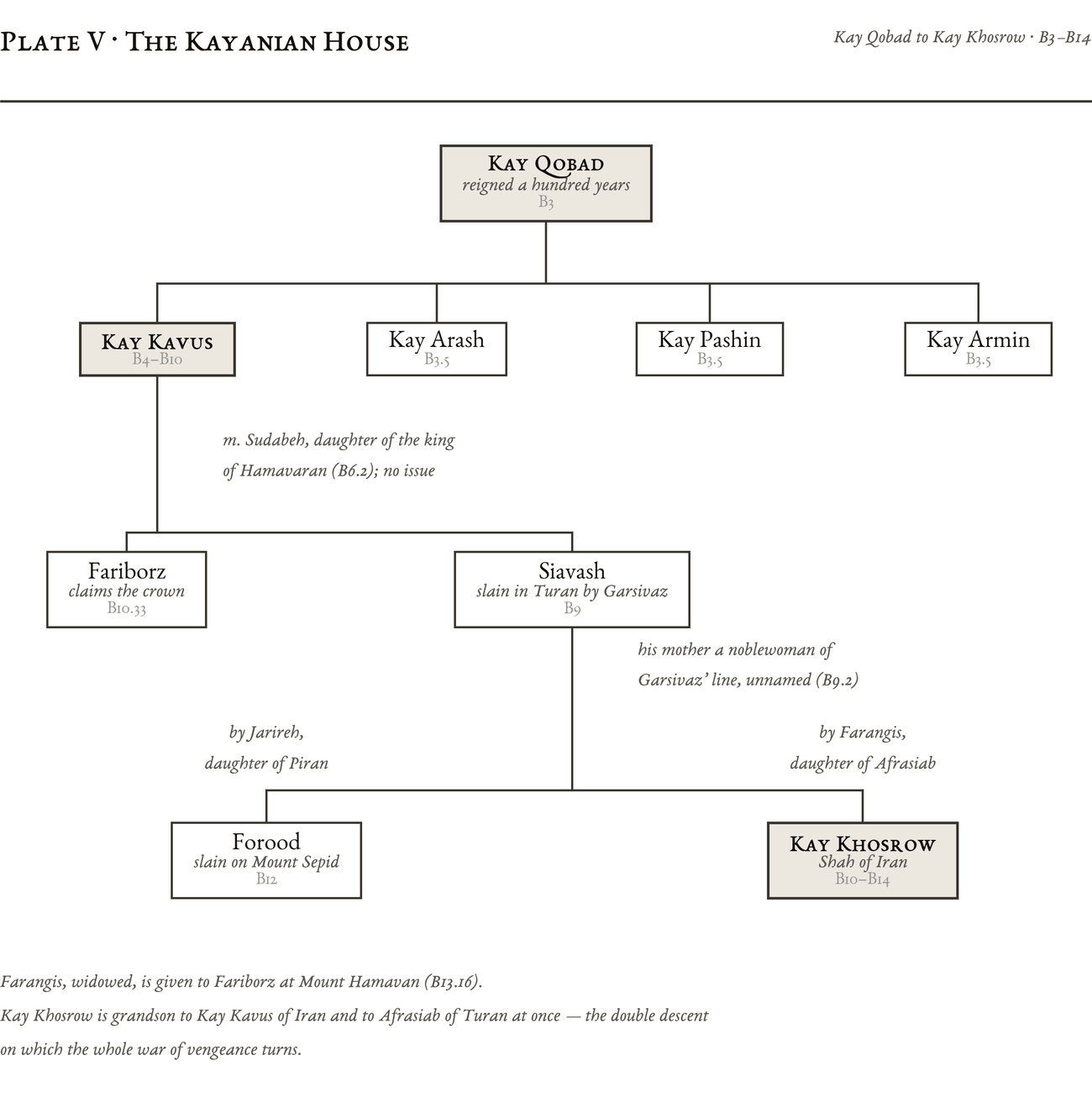
Siavash is born, lovelier than any mortal child, but the astrologers see a troubled star. Rostam asks to raise him and takes him to Zabulistan, where he teaches him riding, archery, justice and command, then sends him back to his father in splendor.
Sudabeh sees Siavash and is seized by passion. When he refuses her secret invitation, she persuades Kavus to send him into the women’s hall to visit his sisters. Siavash suspects a trap, and perhaps a test, but agrees to obey.
Two mountains of timber are soaked in naphtha and lit. Siavash, dressed in white and scented with camphor like a corpse, rides his black horse through the flames and comes out unharmed. The people rejoice, and Kavus begs his son’s forgiveness.
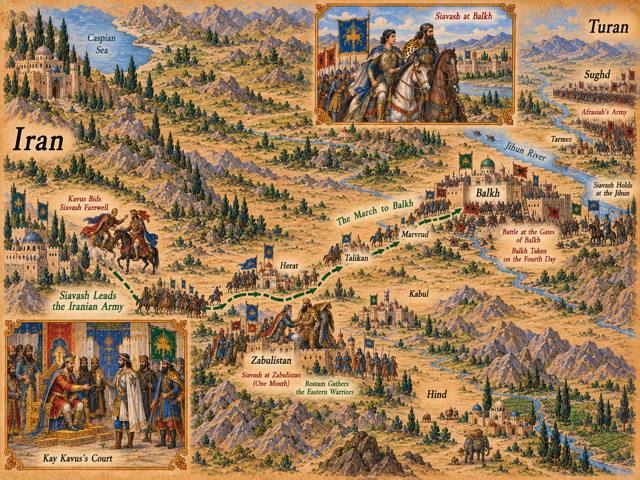
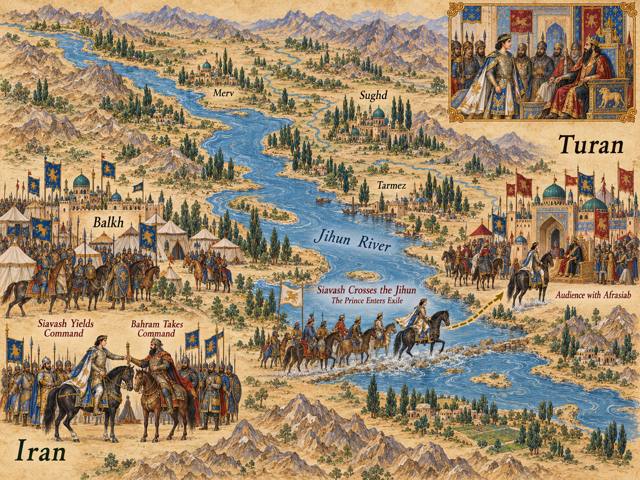
Kavus equips twelve thousand horsemen and twelve thousand foot under the Kaviani banner and parts from Siavash in tears. After a month in Zabulistan, Siavash and Rostam march by Herat to Balkh, defeat the forces of Garsivaz and take the city.
Siavash gives Garsivaz his terms: a hundred of Afrasiab’s kin as hostages, the return of Iranian towns and a withdrawal to Turan. Afrasiab reluctantly agrees, sends the men Rostam named and pulls his army back from Bukhara, Sughd and Samarkand to Gang.
Siavash writes a last bitter letter to Kavus, hands the army and treasure to Bahram, and crosses the Jihun with three hundred riders. Piran meets him in splendor, weeps with him, and pledges his wealth, his kin and his protection.
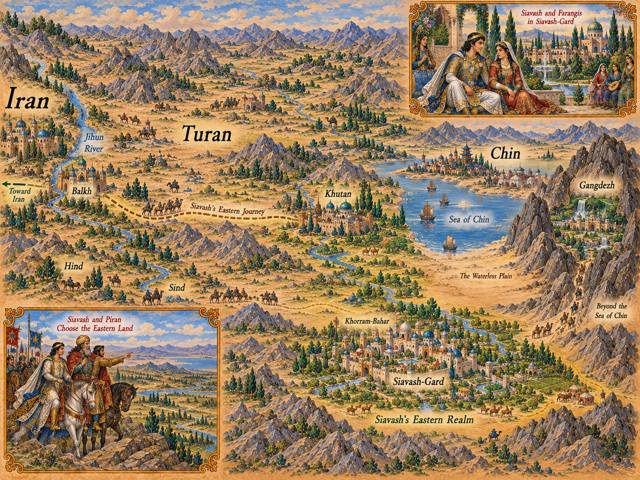
Afrasiab tests his guest at polo, archery and the hunt. Siavash hits the ball out of sight, strings a bow no Turanian can bend, pierces the target and cuts a Gur-e-Khar in equal halves. The king grows fonder, but some Turanians grow uneasy.
Piran and his wife Golshahr prepare a vast dowry of cloth, jewels, gold and servants. Afrasiab gives his daughter in marriage before witnesses, and Farangis is brought to Siavash by night. Seven nights of celebration follow.
Afrasiab summons Siavash back to a new province. The prince travels with great wealth to Khorram-Bahar, lays out a city two farsangs square, fills it with palaces and gardens, and paints its halls with scenes of Kavus, Rostam and Afrasiab. It is named Siavash-Gard.
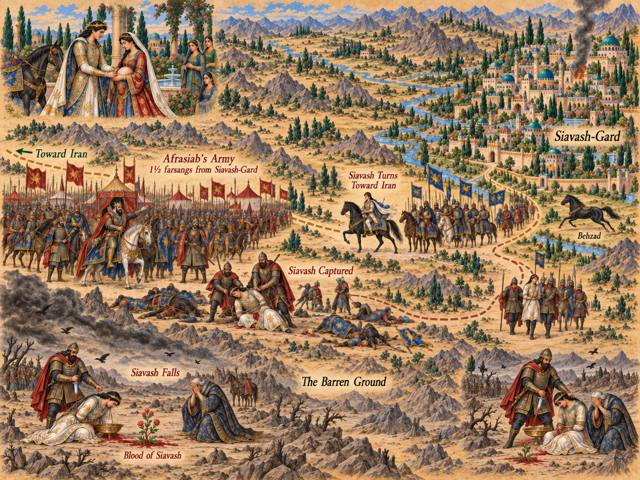
Siavash tells Farangis his fate: he will be beheaded, she will be saved by Piran and bear a son, Kay Khosrow, who will one day avenge him. He frees his black horse Behzad for his son, hamstrings his other horses, burns his treasure, and leaves.
Gurvi drags Siavash to the archery ground and cuts his throat over a golden basin, and a plant springs from the blood poured on barren earth. Darkness covers the world. Afrasiab orders Farangis beaten to kill her unborn child, the nobles protest, and Pilsam rides to warn Piran.
 New Naqqali