 New Naqqali
Bukharaبخارا
A city of Transoxiana.
- In the poem
- First at B9.23, Siavash’s Treaty with Afrasiab; last at E10.13, Bijan Marches against Mahwi
- Named
- 13 times, in 13 sections
- Main stories
- C4 The Final Afrasiab Wars and the Disappearance of Kay Khosrow (3); E1 The Story of Mahbud and Other Matters (3); E10 Yazdegard (3)
In the poem’s own words
Siavash’s Treaty with Afrasiab
Siavash gives Garsivaz his terms: a hundred of Afrasiab’s kin as hostages, the return of Iranian towns and a withdrawal to Turan. Afrasiab reluctantly agrees, sends the men Rostam named and pulls his army back from Bukhara, Sughd and Samarkand to Gang.
- B9.23.30From fair Bukhara, Sughd, and Samarkand,From Chakh and Sipanjab, he drew his hand.
Piran’s Letter to Gudarz
Alarmed by Iran’s mobilization, Piran writes to Gudarz offering peace: every province from Sistan to Sughd returned, treasure and hostages sent, or else the war decided by paired champions. His son Ruyin carries the letter, and Gudarz feasts him for a week without answering.
- C3.20.37Shingan and Tirmid, Visagard I yield,Bukhara and the towns around its field.
Afrasiab Hears of Piran’s Death
At Baikand, Afrasiab learns that Piran, Lahhak and Farshidvard are dead. He mourns, throws down his crown, swears to live as a soldier until he is avenged, pays his troops, leaves Qarakhan in Bukhara, ferries his army over the Jihun and ranks his sons for battle.
- C4.3.76He bade him in Bukhara hold his ground,A mountain at his father’s back be found.
Afrasiab Flees to Gang-Behesht
Afrasiab reaches Qarakhan’s army and mourns his dead. His counselors advise withdrawal across the Gulzaryun, and he goes to Gang-Behesht, where he hunts, feasts and drinks among gardens until his agents report that Khosrow has crossed the Jihun.
- C4.13.6He lingered in Bukhara, sunk in woe,To wait for lions who would face the foe.
Khosrow’s Return from Turan
Khosrow leaves Gostaham to govern from Chin’s sea to Kibchak and starts home with a treasure-train ten days long. He halts at Chakh, Sughd and Bukhara, weeps at an ancient fire temple, crosses the Jihun, and moves by Balkh, Nishapur and Rey toward Pars.
- C4.39.15He marched from there toward famed Bukhara’s wall,While troops concealed the earth from sight of all.
Bahram Marks the Frontier and Crowns Shahra
Bahram crosses the river, breaks the Turkish army beyond it, and accepts tribute and hostages when their chiefs plead for the guiltless. He raises a stone pillar to mark the frontier, forbids crossings without his consent, and crowns Shahra king of Turan.
- D10.21.2He chose Bukhara for his next attack,And set his feet upon the warlike track.
Bahram Returns to Iran in Triumph
Bahram writes Narsi an account of the victory; Iran rejoices, and the nobles who had written to the Khan beg pardon through Narsi and are forgiven. The Shah worships at Azar Abadagan, scatters largess at Istakhr, repairs roads and bridges, and returns to Tisfoon.
- D10.22.37From Chaghan, Khatlan, Balkh, and Bukhara then,The chieftains came with tribute, gifts, and men.
Ghatfar Defeated, Faghanish Crowned
The Khan of Chin sends gifts to Anooshirvan, and Ghatfar the Heytalian intercepts and kills the envoy. The Khan marches; after a week’s battle near Bukhara the Heytalians break. Their people resolve to seek Iran’s protection, and crown Faghanish of Chaghaniyan.
- E1.4.46Bukhara bristled thick with spear and axe;There Ghatfar camped and planned his fierce attacks.
All 13 sections that name Bukhara
- B9.23 Siavash’s Treaty with Afrasiab
- C3.20 Piran’s Letter to Gudarz
- C4.3 Afrasiab Hears of Piran’s Death
- C4.13 Afrasiab Flees to Gang-Behesht
- C4.39 Khosrow’s Return from Turan
- D10.21 Bahram Marks the Frontier and Crowns Shahra
- D10.22 Bahram Returns to Iran in Triumph
- E1.4 Ghatfar Defeated, Faghanish Crowned
- E1.8 The Khan Proposes Alliance by Marriage
- E1.11 Anooshirvan Marches to Tisfoon
- E10.9 Yazdegard Hides in the Mill
- E10.12 Mahwi of Sur Takes the Throne
- E10.13 Bijan Marches against Mahwi
On the maps
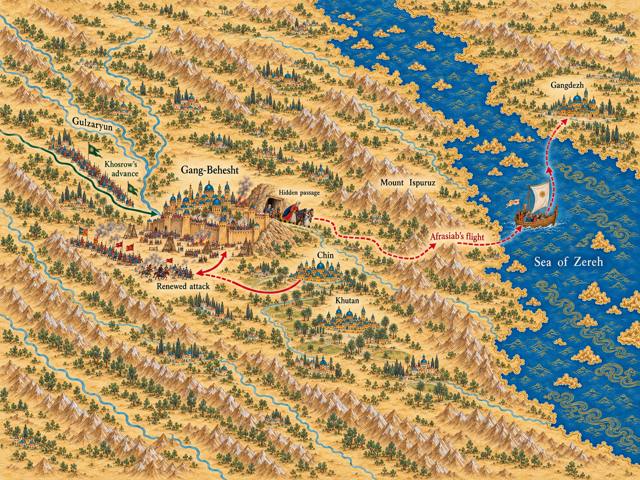
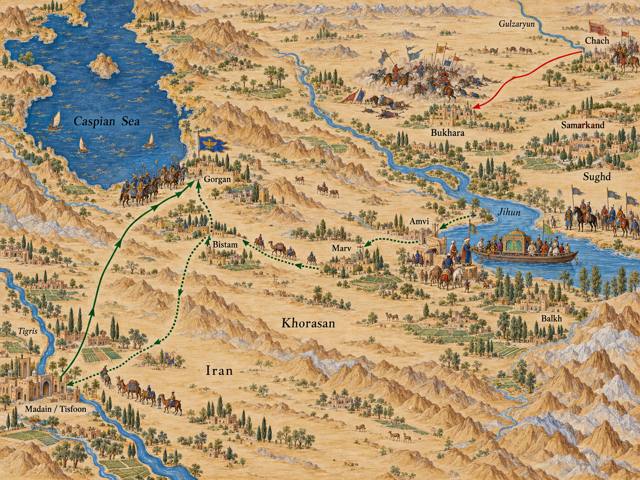
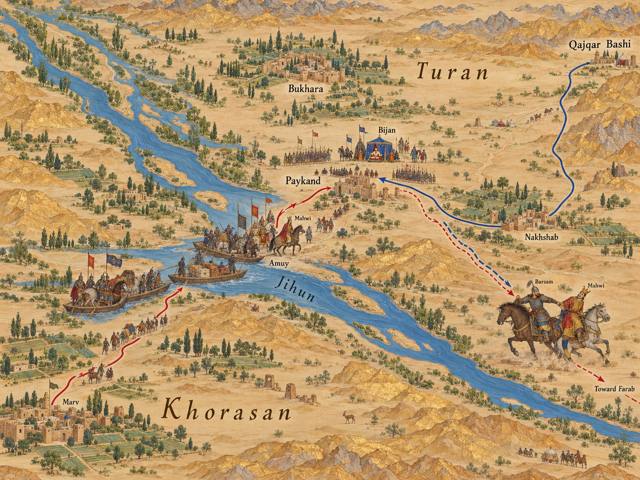
Where the name appears
More in the Glossary and the index of places.