 New Naqqali
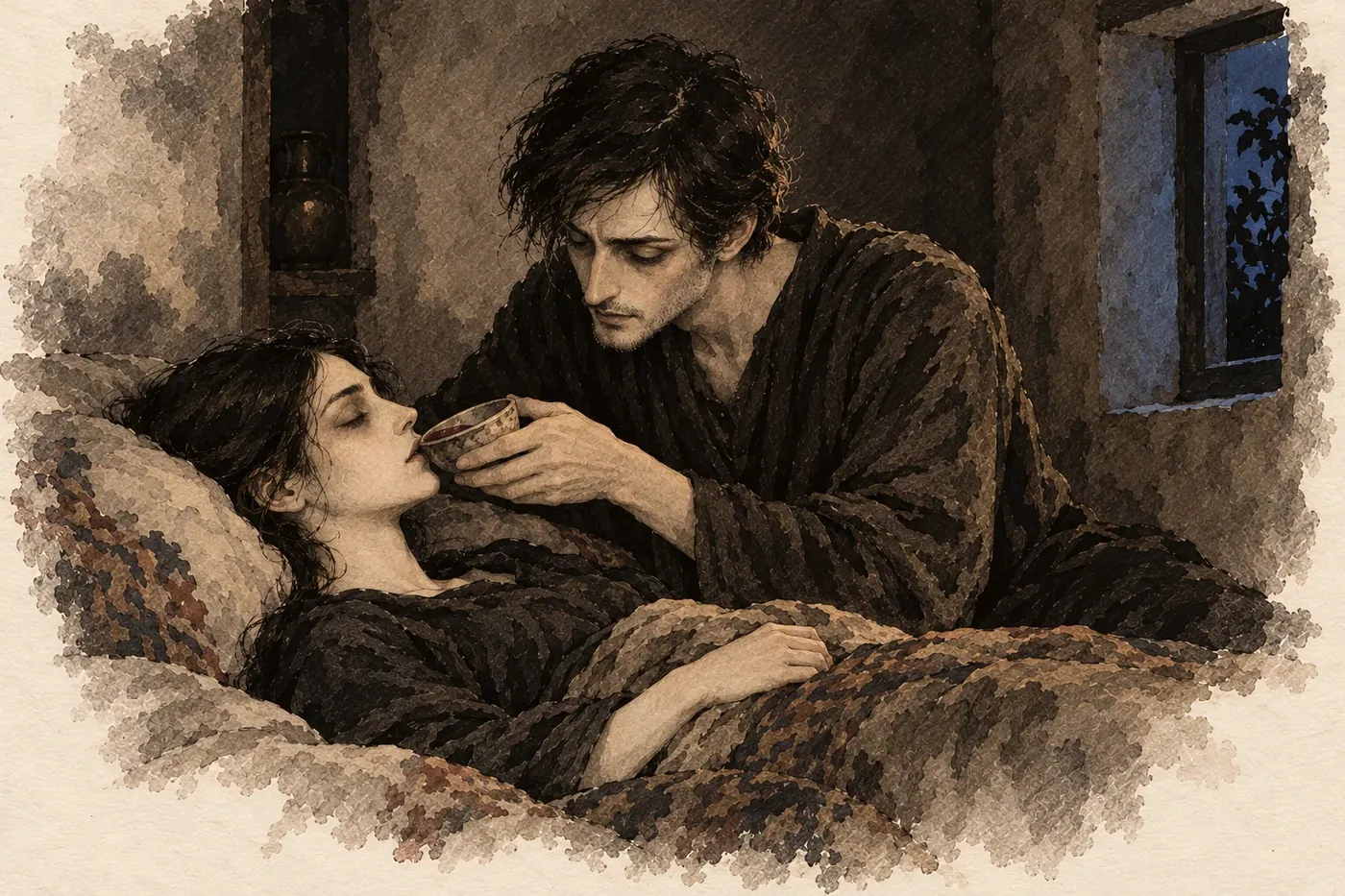
It occurred to me that perhaps she was hungry, or thirsty! I went into the back closet of my room to find something for her, although I knew there was nothing to be found in the house. But it was as if it had been revealed to me: on the high shelf I had a flask of old wine that I had inherited from my father.1 I set the stool in place and brought the flask down. I crept on tiptoe to the bed, and saw that she was asleep like a tired, worn-out child. She was fast asleep, and her long lashes had closed together like velvet. I opened the flask and slowly poured a cup of wine into her mouth, between her clenched teeth.
For the first time in my life, a feeling of calm suddenly came over me. For I saw these closed eyes, and it was as if the demon that tormented me,2 the nightmare that squeezed my insides in its iron claws, had calmed a little. I brought my chair, set it beside the bed, and stared at her face. What a childlike face, what a strange look! Was it possible that this woman, this girl, this angel of torment (for I did not know what name to give her), was it possible that she had this double life? So calm, so simple?
Notes
- ◇ The flask of old wine. It is the same inherited flask he was reaching for when he first saw her through the air-hole. Keep an eye on it. ↩
- demon (salatun): Hedayat’s word means both a devouring disease, like a cancer, and a demon of folk belief. Both senses are meant: the torment that eats him from inside. ↩
This scene on the loop
The lit bead is this scene; red beads are the thread you pick. Gold arcs join it to the scenes it echoes (4, 36). Pick a thread to see where that figure or object comes back; tap any bead to read that scene. The whole loop, with every thread and echo.
This scene in the Persian and literal English, line by line · the scene’s page, with who and what is in it · all scenes