 New Naqqali
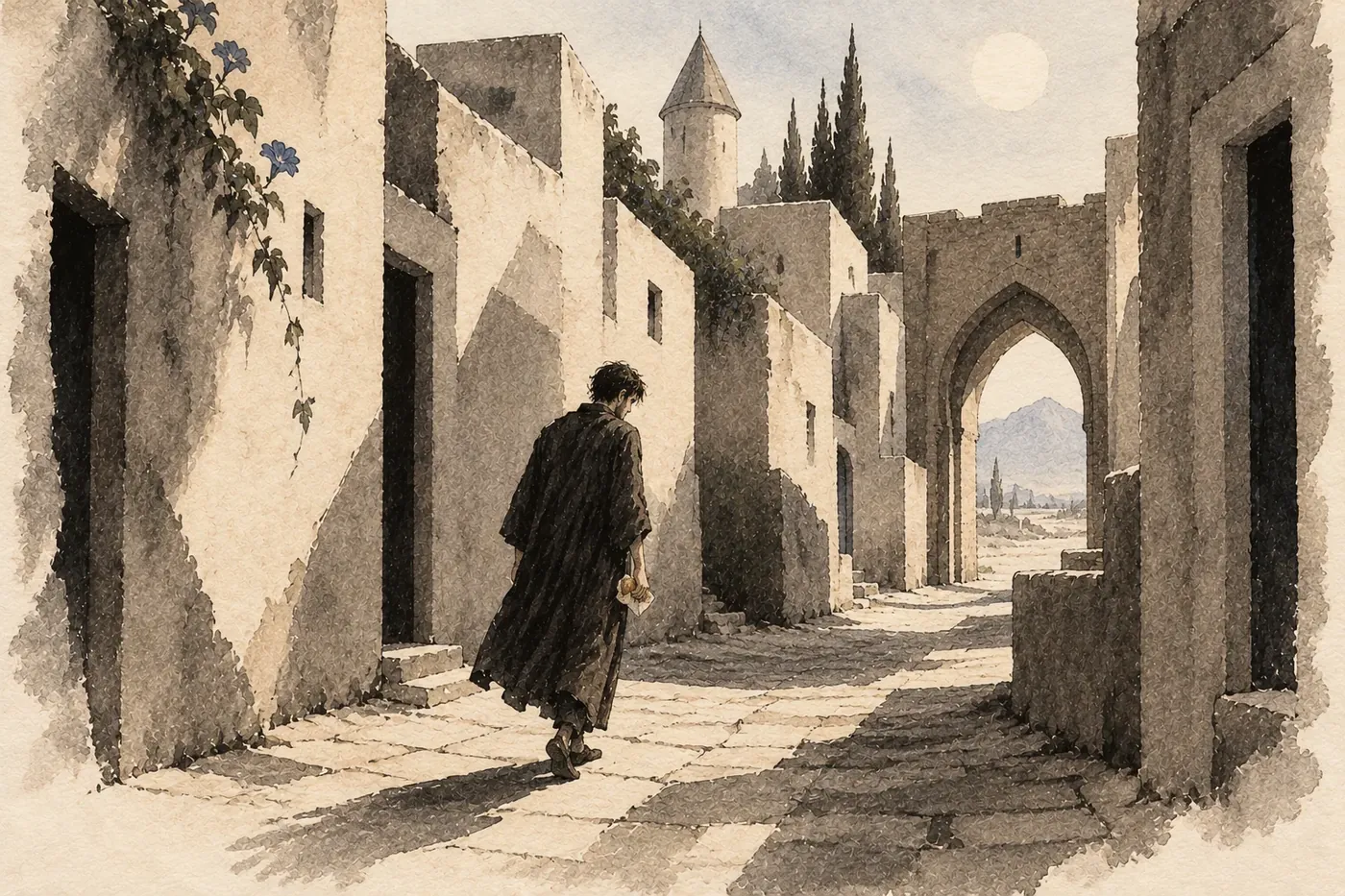
Early in the morning I got up, took two cookies that were on the high shelf, and slipped out of the house without anyone noticing. I fled from the misery that had taken hold of me. With no fixed purpose I wandered through the lanes, and passed, aimless, among the rabble. All of them had greedy faces and were running after money and fame. I had no need to look at them: any one of them stood for all the rest. They were all one mouth, with a bunch of guts hanging from it and ending in their genitals.
Suddenly I felt lighter and more nimble. The muscles of my legs had begun to move with a speed and quickness I could never have imagined. I felt that I had broken free of all the bonds of life. I shrugged my shoulders. It was a natural gesture of mine: as a child, whenever I was freed from the weight of some chore or duty, I made this same movement.
The sun was climbing, and it burned. I came into deserted lanes. Along my way stood gray houses in strange geometric shapes, cubes, prisms, cones, with low, dark openings.1 These openings seemed to have no doors or shutters. They looked ownerless and makeshift. It was as if no living creature could ever have lived in these houses. The sun, like a golden razor, shaved away the edge of the shadow along the wall. The lanes ran on between old whitewashed walls. Everything was quiet and mute, as if all the elements were keeping the sacred law of the burning air’s stillness: the law of silence. Secrets seemed to be hidden everywhere, so that my lungs did not dare to breathe. All at once I noticed that I had passed out through the city gate. The heat of the sun drew the sweat out of my body with a thousand sucking mouths. Under the blazing sun the shrubs of the plain had turned the color of turmeric. The sun, like a feverish eye, poured its burning rays from the depths of the sky over the silent, lifeless land. But the earth and the plants here had a smell of their own, so strong that breathing it brought back moments of my childhood. It did not only bring back the gestures and words of that time. For a moment I felt that whole time inside me, as if it had happened yesterday. A kind of pleasant dizziness came over me, as if I had been born again into a lost world. The feeling was intoxicating. Like sweet old wine, it worked through my veins and sinews to the depths of my being.
In the plain I knew the thorns, the stones, the tree trunks and the little bushes of wild thyme. I knew the homely smell of the grass. I remembered my far-off days. But all these memories had drawn away from me, as if under a spell. They lived a life of their own among themselves, while I was nothing more than a distant, helpless witness, and I felt that a deep whirlpool had opened between me and them. I felt that today my heart was empty. The bushes had lost the magic scent they had then; the cypresses stood farther apart; the hills had grown drier. The being I was then no longer existed. If I had called him up and spoken to him, he would not have heard me or understood what I meant. He had the face of someone I had once known, but he was not me, and not part of me. The world seemed to me an empty, sorrowful house, and anxiety was circling in my chest, as if I now had to go barefoot through every room of this house, looking into each one. I went through room after room, each opening into the next. But when I reached the last room, facing that harlot, the doors behind me closed of their own accord, and only the trembling shadows of walls whose corners had melted away stood guard around me, like Black slave women and slave men.
Notes
- ◇ The geometric houses. Cubes, prisms, cones, with dark openings that no one seems to live behind: the narrator saw houses like these from the hearse in the first part of the book, and they return. ↩
This scene on the loop
The lit bead is this scene; red beads are the thread you pick. Gold arcs join it to the scenes it echoes (19, 47). Pick a thread to see where that figure or object comes back; tap any bead to read that scene. The whole loop, with every thread and echo.
This scene in the Persian and literal English, line by line · the scene’s page, with who and what is in it · all scenes