 New Naqqali
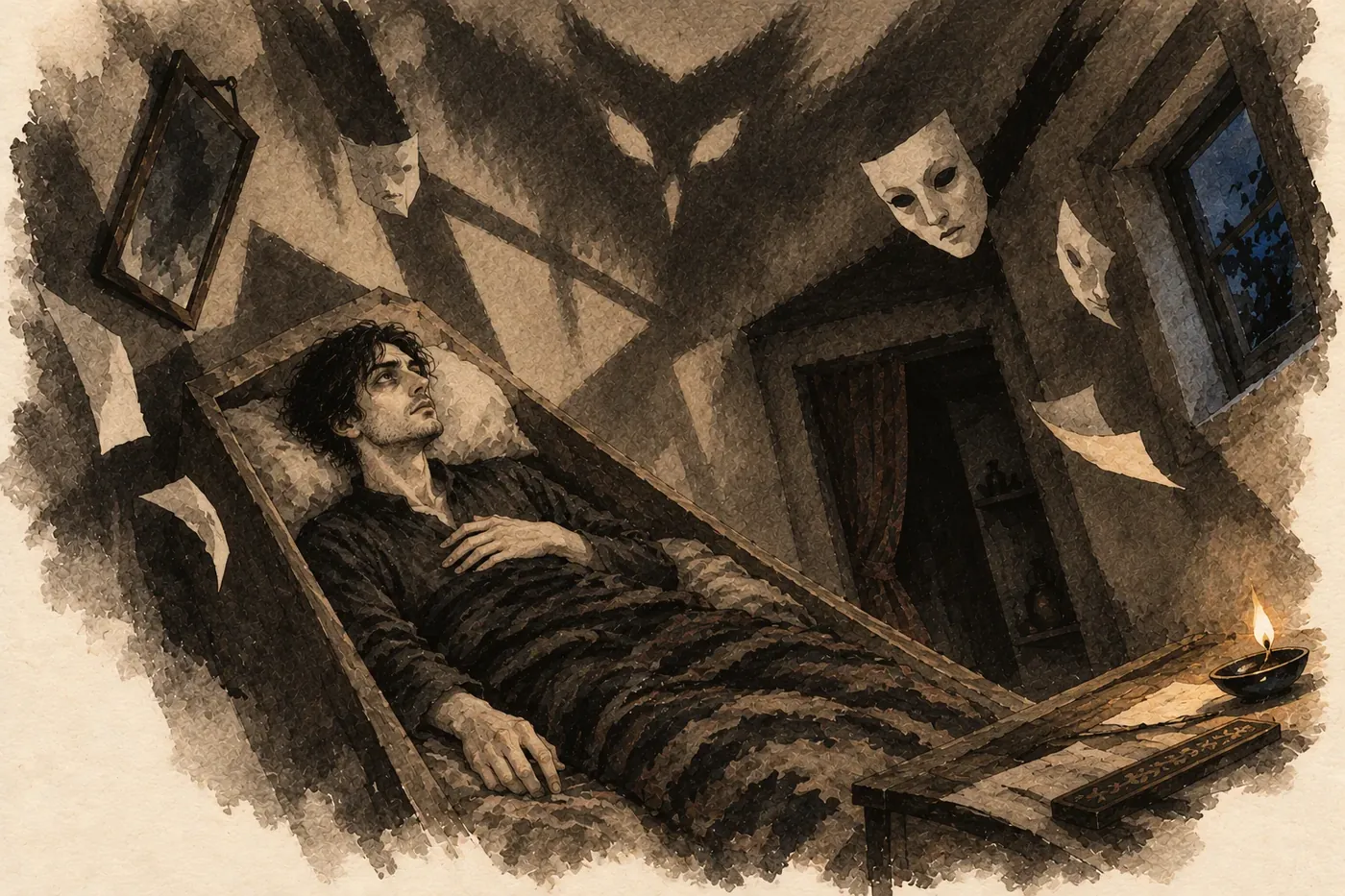
As if I were the one appointed to forgive the living! But none of these silly performances had any effect on me. On the contrary, I enjoyed seeing the rabble too pass, falsely and only for a while, but for a few seconds at least, through the worlds I lived in. Was my room not a coffin? Was my bed not colder and darker than a grave? A bed that always lay spread out, inviting me to sleep. Many times the thought had come to me that I was in a coffin. At night my room seemed to shrink and press in on me. Is this not what they feel in the grave? Does anyone know what is felt after death?
The blood stops in the body, and after a day and a night some parts of the body begin to decay, and yet the hair and nails go on growing for some time after death. Do feelings and thought also die when the heart stops? Or do they go on for a while, living a dim life on what blood is left in the small veins? The feeling of death is frightening in itself, let alone feeling that you are dead! There are old people who die with a smile, as if they were falling asleep, or like an oil lamp going out. But what would someone young and strong feel, who dies suddenly, while all the forces of his body go on fighting against death for a while?
I had often thought about death and about the particles of my body coming apart, so often that the thought did not frighten me. On the contrary, I truly longed to cease to be, to be wiped out altogether. The only thing I feared was that the particles of my body would pass into the particles of the bodies of the rabble. That thought was unbearable to me. Sometimes I wished that after death I could have long arms with long, sensitive fingers, so that I could carefully gather up all the particles of my body and hold on to them with both hands, so that the particles of my body, which are mine, would not pass into the bodies of the rabble. Sometimes I thought that what I was seeing, the dying saw too. Anxiety, dread and terror, and the wish to live, had ebbed away in me. Having thrown away the beliefs that had been drummed into me, I felt a peculiar calm. The only thing that consoled me was the hope of nothingness after death. The thought of living again frightened and wearied me. I had not yet got used to this world I was living in; what use would another world be to me? I felt that this world was not meant for me. It was for a pack of shameless, insolent, beggarly people, peddlers of learning, coarse as muleteers, greedy in eye and heart; for those who had been made to fit the world, who begged and flattered the powerful of earth and heaven like a hungry dog in front of a butcher’s shop, wagging its tail for a scrap of gristle. The thought of living again frightened and wearied me. No, I had no need to see all these sickening worlds and all these wretched faces. Was God such a vulgar show-off that he had to parade his worlds before my eyes? But I cannot lie about it. If a new world had to be passed through, I wished my thoughts and feelings could be numbed and dulled. I wished I could breathe without effort, and, without feeling tired, live out my life for myself in the shade of the pillars of a Lingam temple. I would wander there so that the sun would not strike my eyes, and people’s talk and the noise of life would not scrape my ears.
The deeper I sank into myself, like animals that hide in a hole for the winter, the more I heard other people’s voices with my ears, and my own voice in my throat. The solitude and loneliness hidden behind me were thick and dense, like the nights before time began: nights whose darkness is sticky, thick and contagious, nights that wait to come down over empty cities full of dreams of lust and hatred. But facing this throat that I was to myself, I was nothing more than a kind of absolute, mad affirmation. The pressure that, in the act of making children, clamps two people together to drive away loneliness comes from this same mad side that is in everyone, and it is mixed with a regret that slowly leans toward the depths of death…
Only death does not lie! The presence of death wipes out every illusion. We are the children of death. It is death that saves us from the deceptions of life, and it is death that calls to us from the bottom of life and summons us to itself. At an age when we do not yet understand people’s language, if we sometimes stop in the middle of a game, it is to hear the voice of death. And all through our lives, it is death that beckons to us. Has it never happened to anyone that suddenly, for no reason, he sinks into thought, so deep that he loses all sense of his own time and place and does not know what he is thinking about? Afterward he has to make an effort to become aware again of his outward state and his outward world, and to know them again. That is the voice of death.
In this damp bed that smelled of sweat, when my eyelids grew heavy and I wanted to give myself up to nothingness and eternal night, all my lost memories and forgotten fears came to life again: the fear that the feathers in my pillow would turn into dagger blades; that the button of my coat would grow enormous, as big as a millstone; the fear that a piece of flatbread dropped on the floor would shatter like glass; the worry that if I fell asleep, the oil from the lamp would spill on the floor and the city would catch fire; the obsession that the paws of the dog in front of the butcher’s shop would ring out like horses’ hooves; the dread that the old junk dealer at his wares would start laughing, and laugh so hard that he could not hold back the sound of his own voice; the fear that a worm in the trough round the pool of our house would turn into an Indian snake; the fear that my bed would become a gravestone, swing round on its hinges and bury me, and lock its marble teeth together; the terror that my voice would fail, and however much I screamed, no one would come to help me…
I longed to remember my childhood. But when it came back and I felt it, it was just as hard and painful as those days had been! Coughing that sounded like the coughing of the thin black packhorses in front of the butcher’s shop; having to spit out phlegm, and the fear that a spot of blood might show in it. Blood: this lukewarm, salty, flowing stuff that comes up from the depths of the body, the sap of life, which you have no choice but to vomit up. And the constant threat of death, which tramples all your thoughts, with no hope of return, and passes on. None of it was free of fear and dread.
Life, coldly and indifferently, shows each person his own mask. It seems everyone carries several faces with him! Some people use only one of these masks all the time, and naturally it gets dirty and wrinkled. These are the thrifty ones. Others keep their masks to hand down to their children. And some keep changing their faces, but as soon as they grow old, they realize that this was their last mask, and that it will soon be worn out and ruined. Then their true face comes out from behind the last mask.1
I do not know what poisonous power the walls of my room had, that they poisoned my thoughts! I was certain that a chained madman had been kept in this room before he died. Not only the walls of my room, but the view outside, that butcher, the old junk dealer, my nurse, that harlot, and everyone I saw, and even the bowl I ate my barley soup from, and the clothes on my body: all of them had joined together to breed these thoughts in me.
Notes
- ◇ Masks. Faces as masks, worn out one after another until the true face shows: the narrator will come back to this idea. ↩
This scene on the loop
The lit bead is this scene; red beads are the thread you pick. Pick a thread to see where that figure or object comes back; tap any bead to read that scene. The whole loop, with every thread and echo.
This scene in the Persian and literal English, line by line · the scene’s page, with who and what is in it · all scenes