 New Naqqali
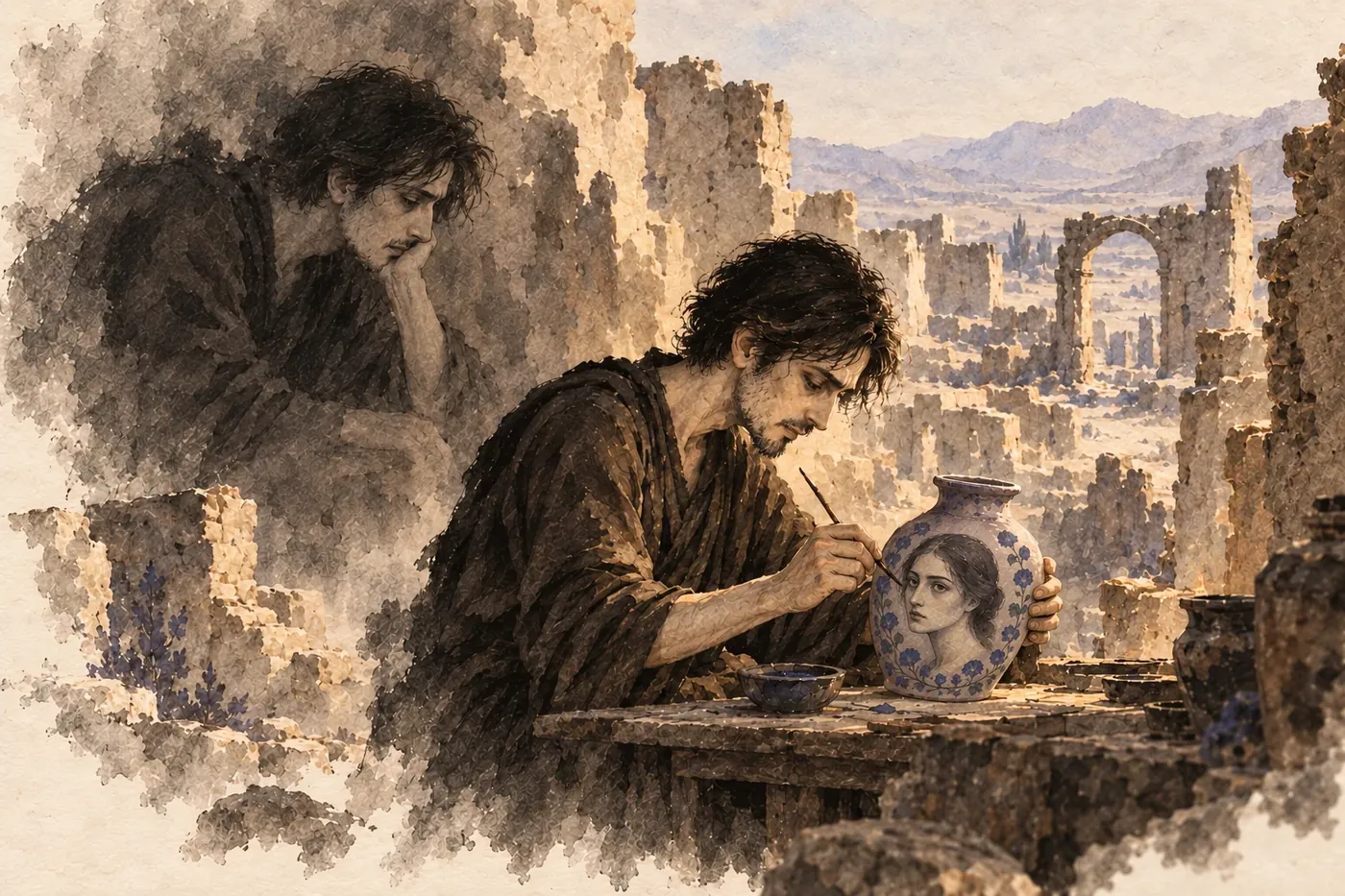
No one can imagine what came over me! I wanted to run away from myself. Was such a thing possible? All the miseries of my life rose before my eyes again. Was it not enough to have had one person’s eyes in my life? Now two people were looking at me with those same eyes, eyes that were hers! No, it was truly unbearable. Eyes whose owner had herself been buried out there, near the mountain, by the trunk of the cypress beside the dry river, under the blue morning glories, in the thick blood, among the worms and creatures and crawling things that were feasting around her, where the roots of plants would soon push into the sockets to suck out their juice: and now they were looking at me, brimming with strong life!
I had not thought myself so wretched and so cursed. And yet, because of a sense of crime hidden in me, at the same time a happiness without reason came over me, a strange happiness, for I understood that I had had a fellow-sufferer, long ago. This ancient painter, the painter who had painted this jar hundreds, perhaps thousands of years ago, was he not my fellow-sufferer? Had he not passed through these same states as I had?
Until this moment I had thought myself the most wretched of all beings. But I came to see that once, on those mountains, in those houses and ruined villages built of heavy bricks, there lived people whose bones had now rotted away, and perhaps the particles of their bodies now lived on in the blue morning glories; and among those people there had been a luckless painter, a cursed painter, perhaps a wretched pen-case maker like me, exactly like me.1 And now I understood, this alone I could understand: that he too had burned and melted away inside two large black eyes, exactly like me. This alone comforted me.
Notes
- ◇ Another double. The painter of the jar, “exactly like me”, joins the narrator’s line of look-alikes, across hundreds or thousands of years. ↩
This scene on the loop
The lit bead is this scene; red beads are the thread you pick. Gold arcs join it to the scenes it echoes (25). Pick a thread to see where that figure or object comes back; tap any bead to read that scene. The whole loop, with every thread and echo.
This scene in the Persian and literal English, line by line · the scene’s page, with who and what is in it · all scenes