 New Naqqali
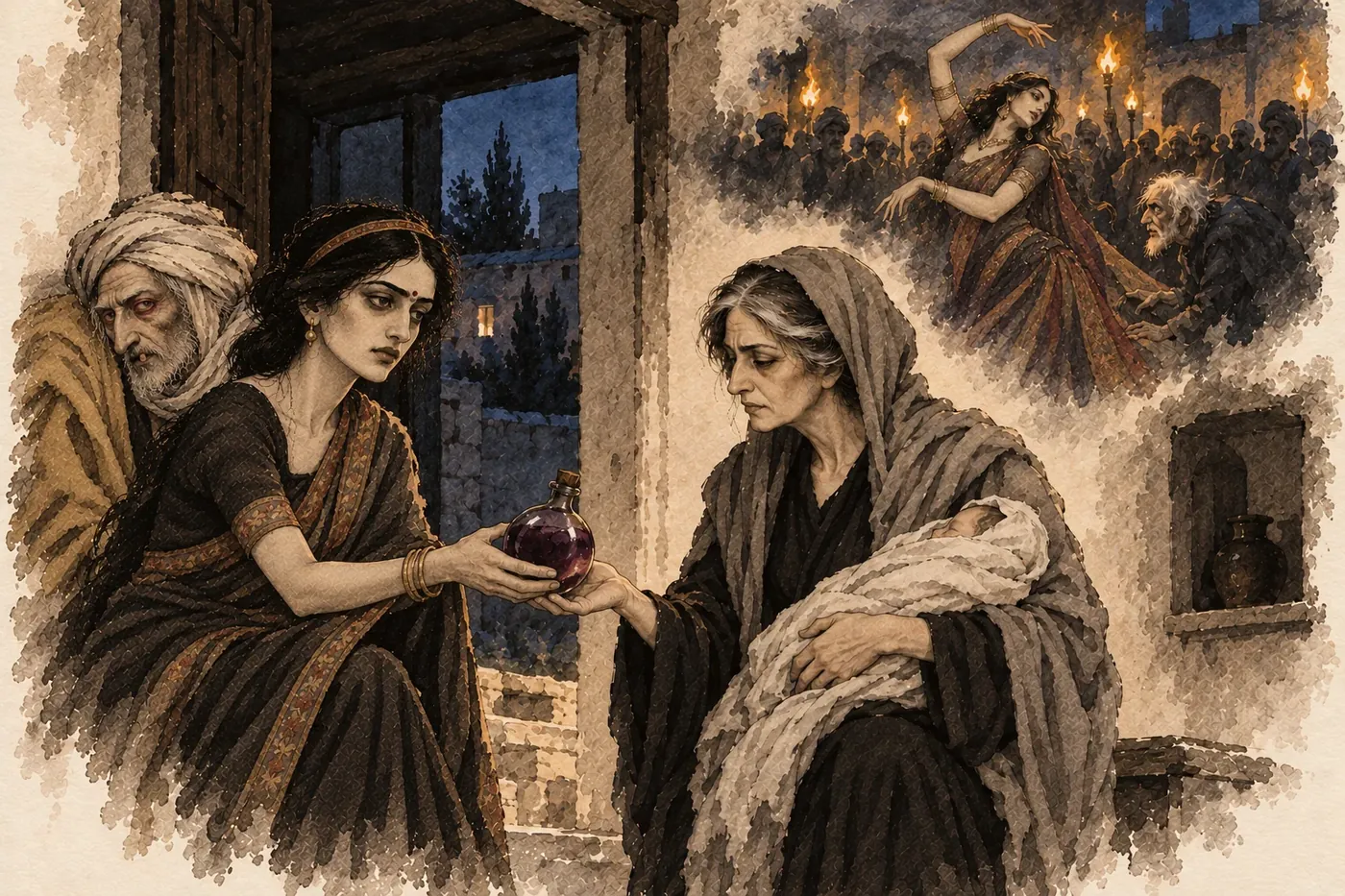
From then on I was nothing but an extra mouth to feed, a stranger. In the end my uncle, or my father, comes back to the city of Ray on business, with the Bugam-Dasi, and brings me and leaves me in the hands of his sister, who is my aunt.
My nurse said that when they said goodbye, my mother left with my aunt, for me, a flask of purple wine,1 in which the venom from the fang of a naga (an Indian snake) had been dissolved. What better thing could a Bugam-Dasi leave her child as a keepsake? Purple wine, the elixir of death, which gives everlasting peace. Perhaps she too had pressed her own life like a bunch of grapes, and given its wine to me! The same poison that killed my father. Now I understand what a precious gift she gave!
Is my mother alive? Perhaps now, while I sit writing, she is twisting and dancing like a snake in the square of some faraway city in India, in the light of a torch, as if a cobra had bitten her. Women and children and curious naked men stand in a ring around her, while my father or my uncle, white-haired and hunched, sits at the edge of the square and watches her. He remembers the dungeon, and the hissing and sliding of the angry snake as it raises its head: its eyes flash, its neck spreads like a ladle, and a line like a pair of spectacles shows dark gray on the back of its neck.
Notes
- ◇ The wine. A flask of wine left for the child: compare the flask of old wine on the high shelf in the first part, which the narrator had inherited and which was made, he said, when he was born. ↩
This scene on the loop
The lit bead is this scene; red beads are the thread you pick. Gold arcs join it to the scenes it echoes (4, 11, 69). Pick a thread to see where that figure or object comes back; tap any bead to read that scene. The whole loop, with every thread and echo.
This scene in the Persian and literal English, line by line · the scene’s page, with who and what is in it · all scenes