 New Naqqali
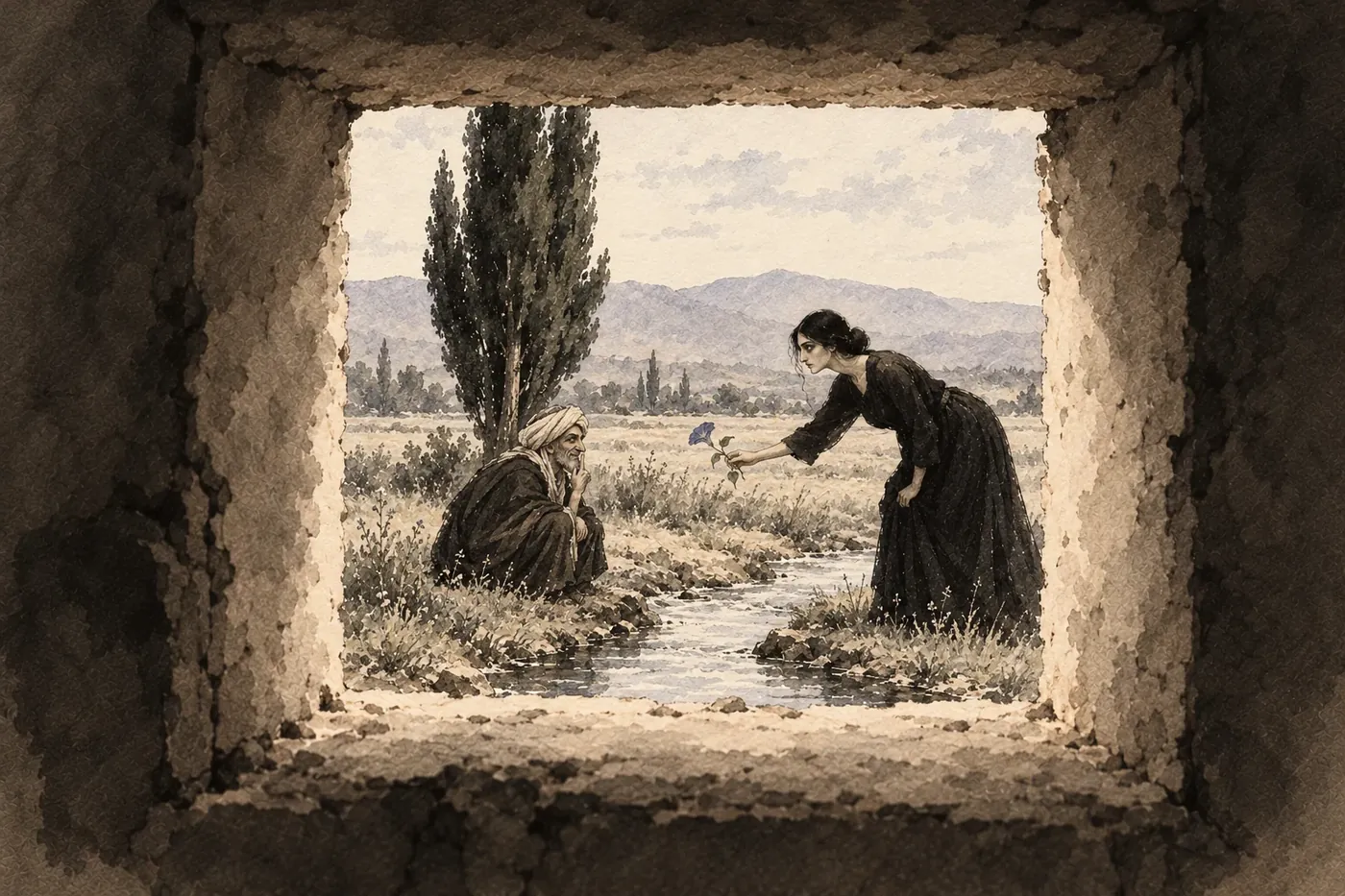
To reach the high shelf, I stood on a stool that was there. But just as I reached for the flask, I suddenly found myself looking outside, through the air-hole above the high shelf. I saw that in the open ground behind my room a hunchbacked old man sat under a cypress tree, and a young girl (no, a heavenly angel) stood before him, bent forward, and with her right hand held out a blue morning glory to him, while the old man chewed the nail of the forefinger of his left hand.
The girl was directly opposite me, but she seemed to pay no attention at all to what was around her. She looked without looking. A dazed, unwilled smile had dried at the corner of her lips, as if she were thinking of someone who was not there. It was from there that I saw her eyes: terrible, bewitching eyes, eyes that seemed to cast a bitter reproach at you, anxious, astonished, threatening and promising eyes. And the ray of my life mingled with those shining hollows so full of meaning, and was drawn down into their depths. That alluring mirror drew my whole being into itself, to a point beyond the power of human thought.
Slanting Turkmen eyes,1 with a supernatural, intoxicating glow, eyes that frightened you and drew you in at the same time, as if they had seen terrible, supernatural sights that not everyone can see. High cheekbones, a high forehead, thin eyebrows that met in the middle, full lips half open, lips that seemed to have just parted from a long, warm kiss and still not had their fill. Tangled, untidy black hair framed her moon-pale face, and one strand of it clung to her temple. The delicacy of her limbs and the ethereal carelessness of her movements told of how frail and fleeting she was. Only a dancing girl from an Indian temple could have moved with her grace and rhythm.
Her sad air and her sorrowful gaiety, all of it showed that she was not like ordinary people. Her beauty was not ordinary at all. She appeared to me like a scene from an opium dream… She roused in me that same heat of the mandrake’s love.2 Her slender, long body, with a line in perfect proportion running down from her shoulder, her arm, her breasts, her chest, her hips and her calves, looked as if it had been pulled from the arms of its mate: she was like the female mandrake torn from the embrace of her mate. She wore a pleated black dress that fitted her closely and clung to her body.
When I looked, she seemed to want to leap over the stream that lay between her and the old man, but she could not. Then the old man burst out laughing. It was a dry, grating laugh that made your hair stand on end. He gave a harsh, cracked, mocking laugh, and his face did not change at all. It was like the echo of a laugh that had come out of emptiness.3
Notes
- Turkmen eyes: slanting, almond-shaped eyes like those of the Turkmen people of Iran’s northeast. In classical Persian poetry they are the eyes of the ideal beloved, and eyebrows that met in the middle, as hers do, were a mark of beauty. ↩
- mandrake (mehrgiyah, “love plant”): a root shaped like a human body. In Persian lore it grows as a male and a female locked in an embrace, and it was used as a love charm. ↩
- ◇ The laugh. Listen for this dry, hollow, cracked laugh. It comes back. ↩
This scene on the loop
The lit bead is this scene; red beads are the thread you pick. Gold arcs join it to the scenes it echoes (3, 7, 8, 9, 10, 18, 34, 35, 37, 45, 50, 76). Pick a thread to see where that figure or object comes back; tap any bead to read that scene. The whole loop, with every thread and echo.
This scene in the Persian and literal English, line by line · the scene’s page, with who and what is in it · all scenes