 New Naqqali
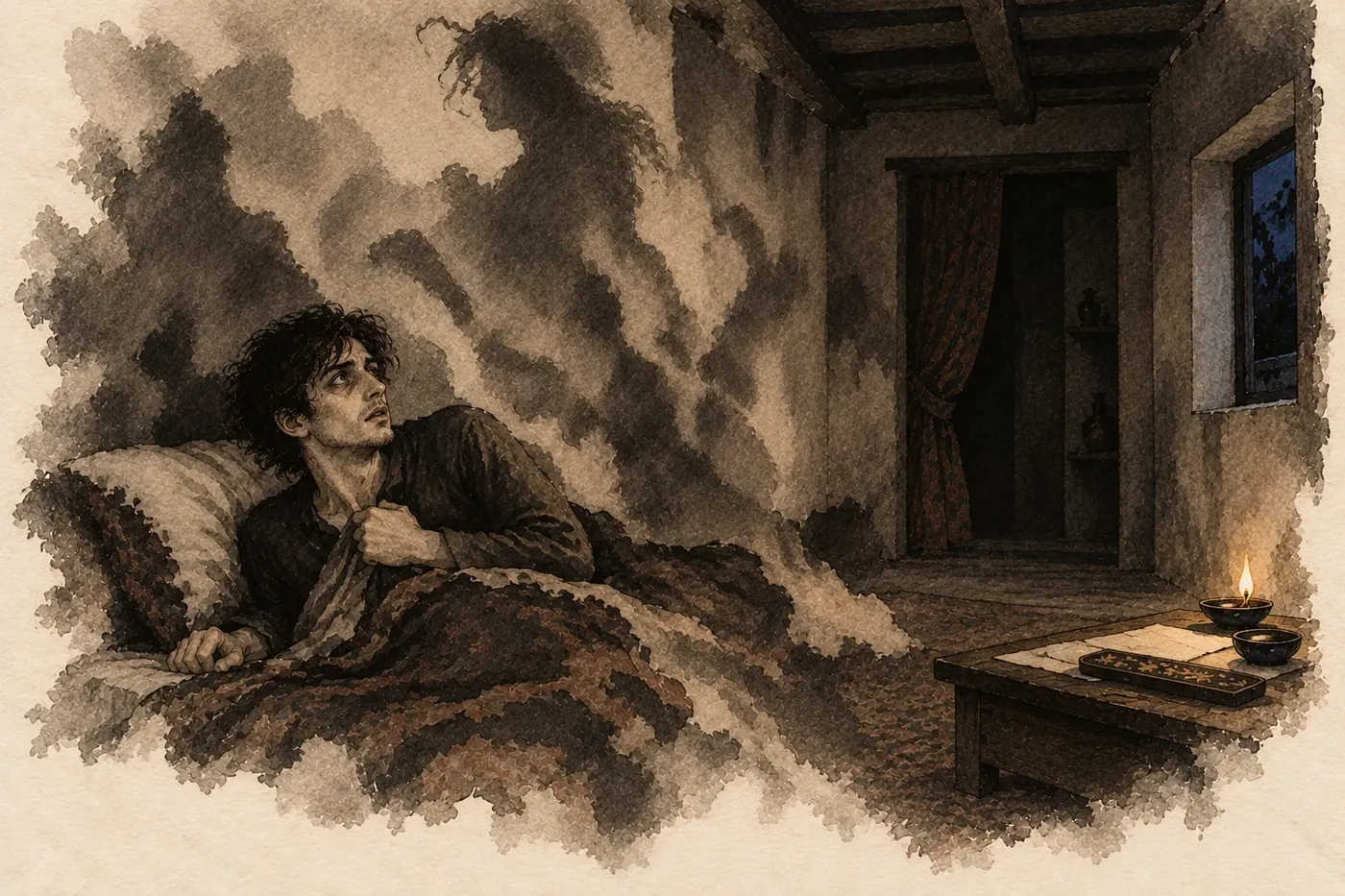
In this room, which every moment grew narrower and darker than a grave around me, I was always waiting for my wife; but she never came. Was it not because of her that I had come to this? It is no joke: it had been three years (no, two years and four months). But what are days and months? They mean nothing to me; for someone who is in the grave, time has no meaning. This room was the tomb of my life and my thoughts. All the bustle, the noise, all the shows of other people’s lives, the life of the rabble, who are all made alike in body and soul, had become strange and meaningless to me. Since I took to my bed, I had woken in a strange, unbelievable world, where I had no need of the world of the rabble: a world inside myself, a world full of unknowns. And it was as if I were bound to explore and search every nook and cranny of it.
At night, when my being wavered on the border between two worlds, a little before the moment when I would sink into a deep, empty sleep, I dreamed. In the blink of an eye I was living a life other than my own, breathing another air, and I was far away. It was as if I wanted to escape from myself and change my fate. When I closed my eyes, my true world appeared to me. These images had a life of their own; they faded and came back freely. It seemed my will had no power over them. But that is not certain either. The scenes that took shape before me were not ordinary dreams, for I had not yet fallen asleep. In silence and calm I told these images apart and compared them with one another. It seemed to me that until then I had not known myself, and that the world as I had pictured it until then had lost its meaning and its power, and in its place the darkness of night ruled; for they had never taught me to look at the night and to love the night.
I do not know whether, at that time, my arm obeyed me or not! I thought that if I left my hand to itself, some unknown, strange impulse would set it working on its own, without my being able to interfere with its movements or control them. If I did not keep constant watch over my whole body, and keep my mind on it without meaning to, it could do things I did not expect at all. I had long had this feeling, that I was decomposing while still alive. Not only my body: my soul too was always at odds with my heart, and the two could not get along. I was always going through a strange kind of dissolving and decay. Sometimes I thought things that I myself could not believe. Sometimes a feeling of pity rose in me, while my reason reproached me. Often, when I was talking to someone, or doing something, I would get into arguments about all kinds of subjects, while my mind was somewhere else: I was busy with my own thoughts, and in my heart I was blaming myself.
I was a heap in the process of dissolving and decaying. It seems I have always been like this, and always will be: a strange, ill-matched mixture... What is unbearable is that I felt far from all these people I saw and lived among, and yet an outward likeness, a likeness dim and distant and at the same time close, bound me to them. It was these very needs of life we shared that lessened my astonishment. The likeness that tormented me most was that the rabble, like me, liked this harlot (my wife), and she was more drawn to them. I am sure there was some flaw in the being of one of us.
I named her the harlot, because no name fitted her so well. I do not want to say “my wife”, because there was nothing of husband and wife between us, and I would be lying to myself. From the first day of time I have always called her the harlot. But this name had a particular pull. If I married her, it was because she came to me first; and that too was out of her cunning and deceit. No, she had no feeling for me at all. How could she ever have come to care for anyone? A lustful woman, who needed one man for her lust, one for lovemaking, and one to torment. I do not think she was content even with this trinity! But she had certainly chosen me to torment; and in truth she could not have chosen better. But I married her because she looked like her mother; because she had a dim, distant likeness to me.
Now I not only loved her: every particle of my body wanted her. Above all, the middle of my body; for I do not want to hide real feelings under the make-believe wrappings of love and affection and theology. For literary huzvaresh1 does not taste good in my mouth. I imagined that a kind of radiance, or halo (like the halo painted round the heads of the prophets), was rippling in the middle of my body, and that my sick, suffering halo must have been seeking out the halo in the middle of her body, and drawing it toward itself with all its strength.
Notes
- huzvaresh: in Middle Persian writing, Aramaic words written on the page but read aloud as Persian ones. Hedayat, a scholar of Middle Persian, uses it for stilted, borrowed, bookish language. ↩
- ◇ Canker. The word is khoreh again, the canker of the book’s first sentence, the wound that eats the soul away in solitude. ↩
This scene on the loop
The lit bead is this scene; red beads are the thread you pick. Pick a thread to see where that figure or object comes back; tap any bead to read that scene. The whole loop, with every thread and echo.
This scene in the Persian and literal English, line by line · the scene’s page, with who and what is in it · all scenes