 New Naqqali
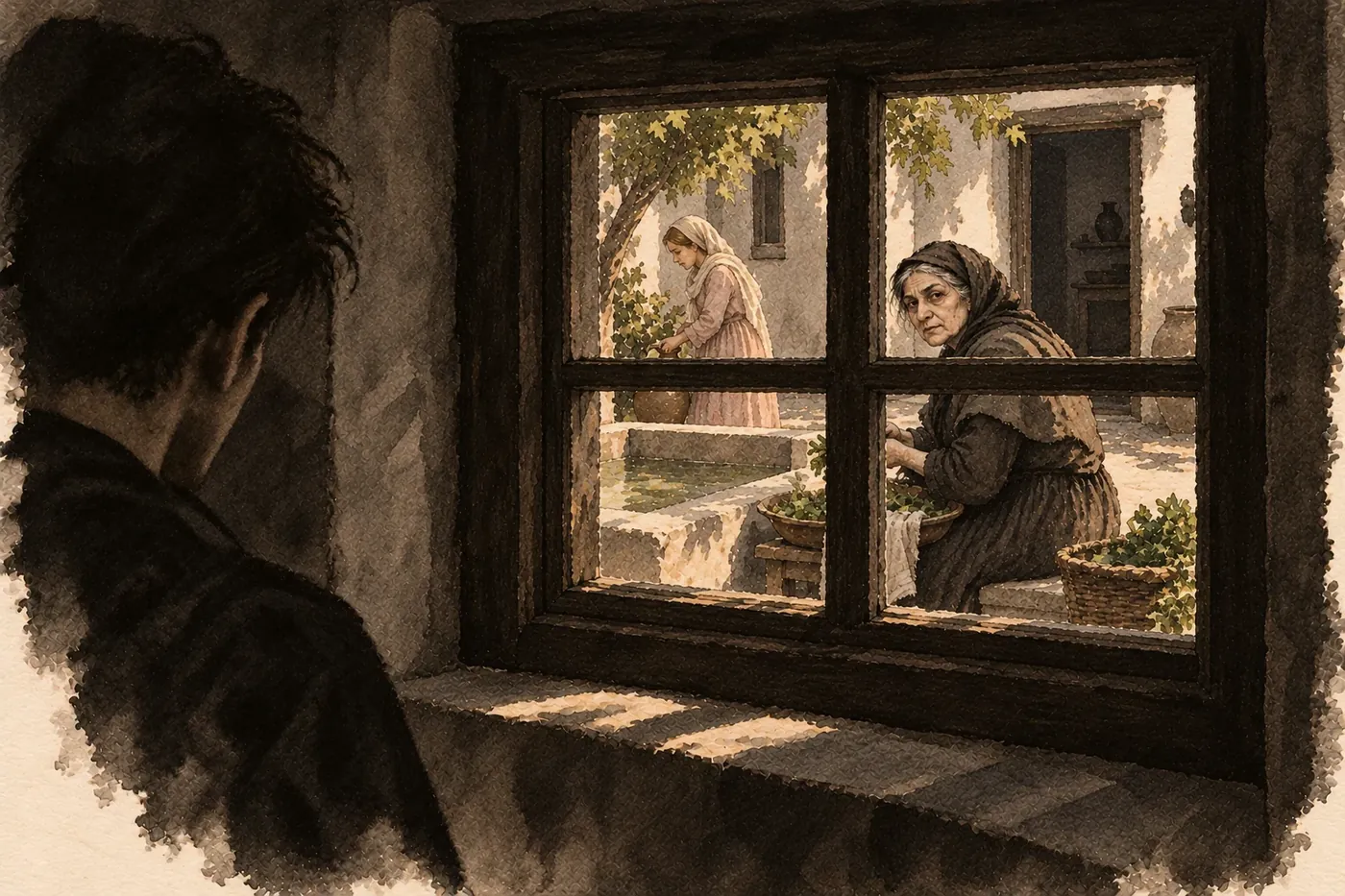
When I got up from beside the brazier, I went to the window that looks onto our courtyard. I saw my nurse sitting in the sun, cleaning herbs. I heard her say to her daughter-in-law, “We’re all sick at heart. If only God would kill him and let him rest.” The physician must have told them that I would not get well. But I was not surprised at all. How foolish these people are! An hour later, when she brought me a herbal brew, her eyes were red and swollen from crying. But in front of me she forced a smile. They were putting on an act in front of me, and how clumsily! They thought I did not know! But why did this woman show me such affection? Why did she think she shared my pain? One day they had paid her, and she had stuffed her wrinkled black breasts into my mouth like a little water bucket. If only a canker had eaten her breasts away! Now, when I saw her breasts, I felt sick to think that back then I had sucked the sap of her life with the greatest appetite, and that the warmth of our bodies had mingled. She used to handle my whole body, and that was why, even now, she treated me with the particular boldness a woman without a husband may have. She looked at me with the same eyes as when I was a child, because there was a time when she held me up over the privy hole. Who knows, perhaps she even rubbed herself against me, the way women do with the adopted sisters1 they choose for themselves. Even now, with what curiosity and care she turned me this way and that and, as she put it, kept me washed and dried! If my wife, that harlot, had looked after me, I would never have let Naneh-Joon near me, because I thought that my wife’s range of thought and her sense of beauty were wider than my nurse’s, or else that it was only desire that had made me feel this shame and modesty. That is why I felt less shy in front of my nurse, and she was the only one who looked after me.
My nurse must have believed it was fate, that it was written in her stars. Besides, she took advantage of my illness to pour out to me all her family troubles, her pleasures, her quarrels and fights, and her own simple, sly, beggarly soul. And with what spite she told me of her grudge against her daughter-in-law, as if the girl were her co-wife and had stolen her son’s love and desire from her! Her daughter-in-law must be pretty! I have seen her from the window that looks onto the courtyard: she had hazel eyes, fair hair and a small, fine nose.
Sometimes my nurse told me about the miracles of the prophets; she thought she could comfort me that way. But I envied her low thinking and her stupidity. Sometimes she brought me gossip. A few days ago, for instance, she told me that “my daughter”, meaning that harlot, was sewing a burial shirt2 for the baby at a lucky hour, for her own baby. Then she comforted me, as if she too knew. Sometimes she goes round the neighbors to get remedies for me. She goes to sorcerers, fortune-tellers and bowl-diviners, has the book opened for omens, and asks their advice about me. On the last Wednesday of the year3 she had gone out to listen for omens, and she brought back a bowl of onions, rice and rancid oil. She said she had begged them for my recovery, and she fed me all this filth and muck in secret. Every so often she also bound the physician’s brews to my navel, those same wretched brews he had prescribed for me: hyssop, licorice paste, camphor, maidenhair fern, chamomile, goose fat, flaxseed, pine seeds, starch, flixweed and a thousand other kinds of rubbish... A few days ago she had brought me a prayer book with a handspan of dust on it. Not only prayer books: no kind of book or writing, none of the ideas of the rabble, were any use to me. What need had I of their lies and humbug? Was I not myself the outcome of a long line of past generations? Did their inherited experience not live on in me? Was the past not inside me? But never had the mosque, or the call to prayer, or the washing before prayer, or the hawking and spitting, or the bending down and straightening up before an Almighty, an absolute master with whom one has to chat in Arabic, had any effect on me. It is true that in the past, when I was well, I had gone to the mosque several times because I had to, and had tried to bring my heart into tune with other people’s. But my eyes would fix on the glazed tiles and the patterns on the mosque walls, which carried me off into pleasant dreams, and in this way, without meaning to, I found myself a way of escape. When I prayed, I shut my eyes and held my palms up in front of my face. In this night I had made for myself, I recited the prayers the way one repeats words in a dream, without the mind answering for them. But these words did not come from the bottom of my heart, because I would rather have talked to a friend or someone I knew than to God, to the Almighty! For God was too much for me. When I lay in a warm, damp bed, none of these questions was worth a grain of barley to me. At such a time I did not want to know whether there really is a God, or whether he is only an image of the rulers of the earth, who dreamed him up to shore up their claim to divine power and to plunder their subjects, casting the picture of the earth onto the sky! I only wanted to know whether I would live through the night until morning. I felt how weak and childish religion and faith and belief were in the face of death, almost a kind of pastime for the healthy and the fortunate! Before the terrible truth of death and the agonies I was going through, everything they had drilled into me about the soul’s punishment and reward and the Day of Resurrection had become a stale deception, and the prayers they had taught me were no use against the fear of death.
No, the fear of death would not let go of me. Those who have not suffered will not understand these words. The feeling of life had grown so strong in me that the smallest moment of happiness made up for long hours of suffocation and anxiety. I saw that pain and suffering existed, but they had no meaning or sense at all. Among the rabble I had become an unknown, unrecognized race, so much so that I had forgotten I once belonged to their world. What was terrible was that I felt I was neither truly alive nor truly dead. I was only a moving corpse, with no tie to the world of the living, and no share in the forgetting and the rest of death.
Notes
- adopted sisters (khahar-khandeh): a sworn sisterhood between two women, which could also cover a love affair between them. ↩
- burial shirt (pirhan-e qiyamat, “shirt of the Resurrection”): a shirt written over with prayers, sewn in advance at a lucky hour and kept for one’s burial. ↩
- last Wednesday of the year (Chaharshanbe Suri): a festival held on the evening before the last Wednesday of the Persian year. That night people listen secretly to passers-by and take the first words they overhear as an omen (fal-gush). ↩
This scene on the loop
The lit bead is this scene; red beads are the thread you pick. Pick a thread to see where that figure or object comes back; tap any bead to read that scene. The whole loop, with every thread and echo.
This scene in the Persian and literal English, line by line · the scene’s page, with who and what is in it · all scenes