 New Naqqali
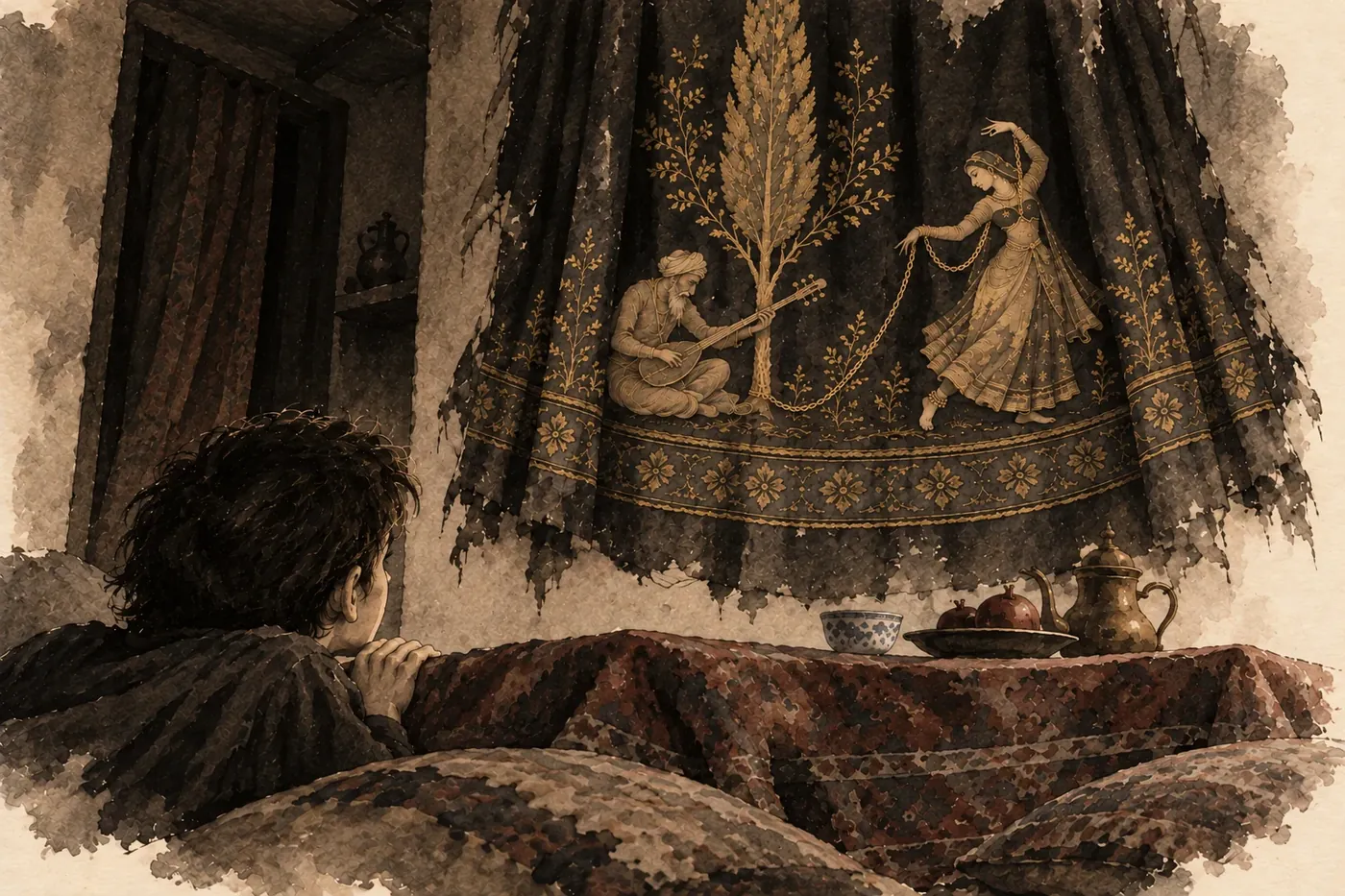
Naneh-Joon treated me like a child. She wanted to see every part of me. I still felt shy in front of my wife. When she came into my room, I would cover up the phlegm I had spat into the basin. I combed my hair and beard. I straightened my nightcap. But in front of my nurse I felt no shyness at all. Why had this woman, who was nothing to me, worked herself so far into my life? I remember that in this very room, over the cistern, they used to set up a korsi1 in winter. My nurse and I slept around the korsi with this same harlot. In the half-light, when my eyes opened, the design on the embroidered curtain that hung in front of the door would come alive before my eyes. What a strange, frightening curtain it was! On it, a hunched old man like the yogis of India, with a turban wound round his head, sat under a cypress tree holding an instrument like a sitar. A beautiful young girl, like a Bugam-Dasi, a dancer of the temples of India, had her hands in chains, and it seemed she was forced to dance in front of the old man!2 I imagined that perhaps this old man, too, had been thrown into a dungeon with a cobra, and that this was why he looked the way he did, and why his hair and beard had turned white. It was one of those Indian curtains embroidered with gold that my father or my uncle had perhaps sent from distant lands. When I looked at this design too closely, I grew afraid. I would wake my nurse, heavy with sleep. With her foul breath, and her coarse black hair rubbing against my face, she would hold me tight against her.
In the morning, when I opened my eyes, she looked to me just as she had then. Only the lines of her face had grown deeper and harder. Often, to forget, to escape from myself, I call back the days of my childhood, to feel myself as I was before I fell ill, to feel that I am well. I still felt that I was a child, and that for my death, for my wiping out, there was a second self who took pity on me, on this child who was going to die. In the frightening moments of my life, as soon as I saw my nurse’s calm face, her pale face, her sunken eyes, still and dull, the thin wings of her nose and her broad, bony forehead, the memories of that time woke in me. Perhaps mysterious waves flowed from her that soothed me. On her temple there was a fleshy mole with hair growing out of it. It was as if I had noticed her mole only today. Before, when I looked at her face, I had never looked so closely. Although Naneh-Joon had changed outwardly, her thoughts had stayed as they were. Only, she showed more love of life, and she was afraid of death. Like the flies that took refuge in the room at the start of autumn. But my life changed every day and every minute. It seemed to me that time, and the changes people might go through over many years, ran for me thousands of times faster, multiplied thousands of times over, while the happiness in it went the other way, down toward zero, and perhaps even below zero. There are people who begin their death struggle at twenty, while many others go out only at the hour of their death, very quietly and slowly, like an oil lamp whose oil has run out.
Notes
- korsi: a low table set over a brazier of coals and covered with a large quilt; in winter the family sat and slept around it with their legs under the quilt. The cistern was a covered store of water under the room. ↩
- ◇ The picture again. A hunched old man under a cypress and a girl before him: the scene of the pen cases, here woven into a curtain from India, with the girl in chains. ↩
This scene on the loop
The lit bead is this scene; red beads are the thread you pick. Gold arcs join it to the scenes it echoes (3, 5, 35, 61). Pick a thread to see where that figure or object comes back; tap any bead to read that scene. The whole loop, with every thread and echo.
This scene in the Persian and literal English, line by line · the scene’s page, with who and what is in it · all scenes