 New Naqqali
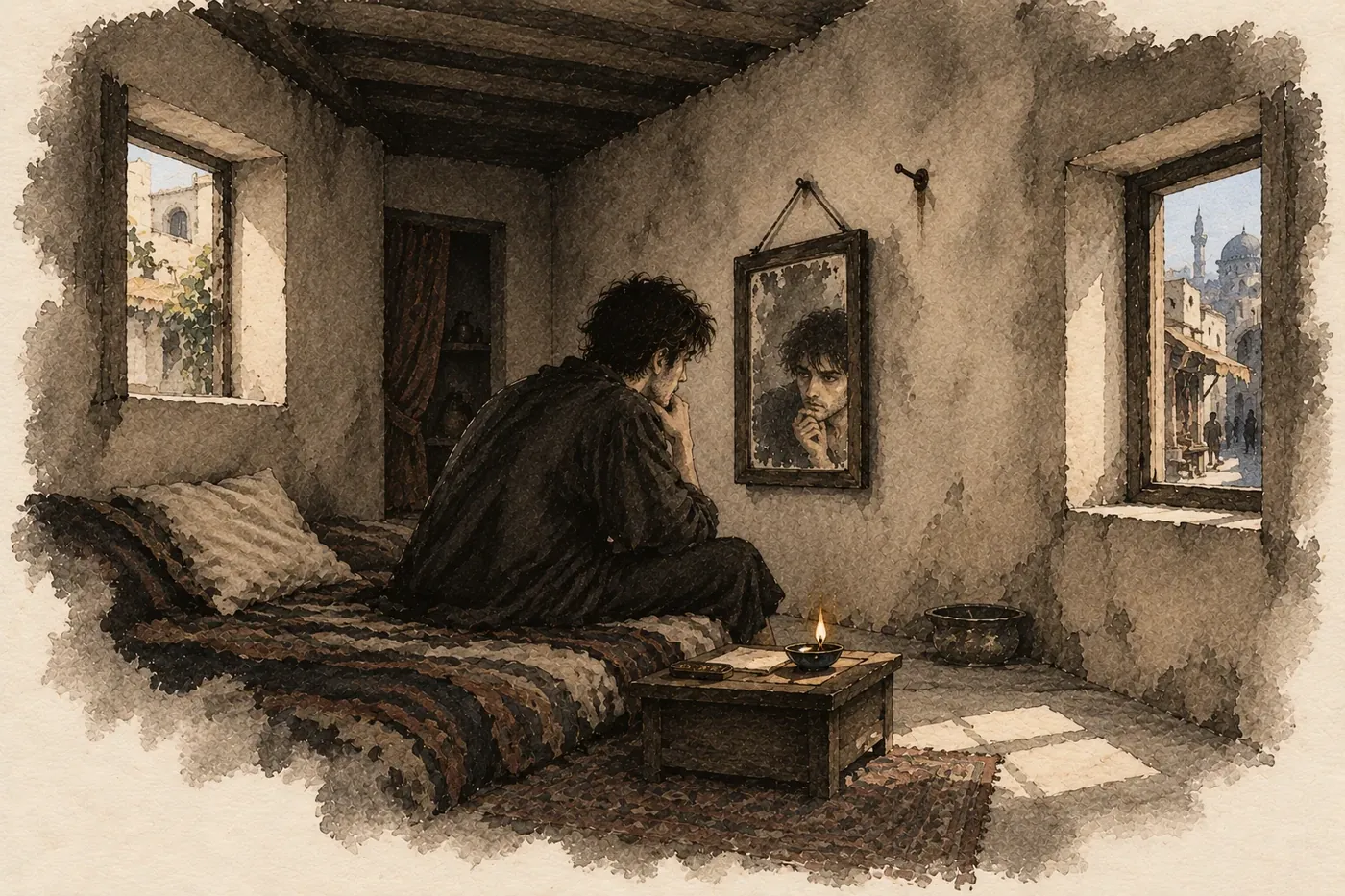
Within the four walls that make up my room, and the fence that has been drawn around my life and my thoughts, my life melts away little by little like a candle. (No, I am wrong.) It is like a log of wet wood lying in a corner of the hearth, scorched and charred by the fire of the other logs. It has neither burned nor stayed green and fresh; it has only been choked by the smoke and fumes of the others. My room, like all rooms, is built of mud brick and brick on the ruins of thousands of old houses. It has whitewashed walls and a band of inscription running round them. It is exactly like a tomb. The smallest feature, the smallest detail of my room is enough to keep my mind busy for long hours, like the spider’s work in the corner of the wall; for since I took to my bed, they look after my things less. A big stable nail is driven into the wall. That was where the cradle of my wife and me hung, and perhaps later it bore the weight of other children too. A little below the nail, a board has come loose from the plaster of the wall, and from under it you can smell the things and the beings that were in this room before. Until now no current of air, no wind, has been able to scatter these stubborn, sluggish, heavy smells: the smell of sweat, the smell of old illnesses, the smell of breath, the smell of feet, the smell of bodies, the smell of urine, the smell of rancid oil, of rotting straw matting and burned omelet, the smell of fried onions, of herbal brews, of mallow and a baby’s diapers, the smell of the room of a boy who has just come of age,1 the smell of vapors drifting in from the alley, and smells that are dead or dying, which are all still alive and have kept their own mark. There are many other smells too, whose origin and source are unknown, but which have left their trace.
My room is a dark back closet. Through two small windows it is joined to the outside, to the world of the rabble. One of them opens onto our own courtyard, and the other onto the alley. From there it joins me to the city of Ray, the city they call the bride of the world, with its thousands of lanes and back lanes and battered houses, its schools and its caravanserais. A city reckoned the greatest city in the world breathes and lives behind my room. Here in the corner of my room, when I close my eyes, the faint, mingled shadows of the city (whatever of it has left its mark on me), with its palaces, its mosques and its gardens, all take shape before my eyes. These two windows join me to the outside world, to the world of the rabble.
But in my room there is a mirror on the wall, in which I see my own face. In my narrow life the mirror matters more than the world of the rabble, which has nothing to do with me.
Notes
- a boy who has just come of age: literally, a boy who has just become bound by religious duty, that is, who has reached puberty and must now pray and fast like a man. ↩
This scene on the loop
The lit bead is this scene; red beads are the thread you pick. Pick a thread to see where that figure or object comes back; tap any bead to read that scene. The whole loop, with every thread and echo.
This scene in the Persian and literal English, line by line · the scene’s page, with who and what is in it · all scenes