 New Naqqali
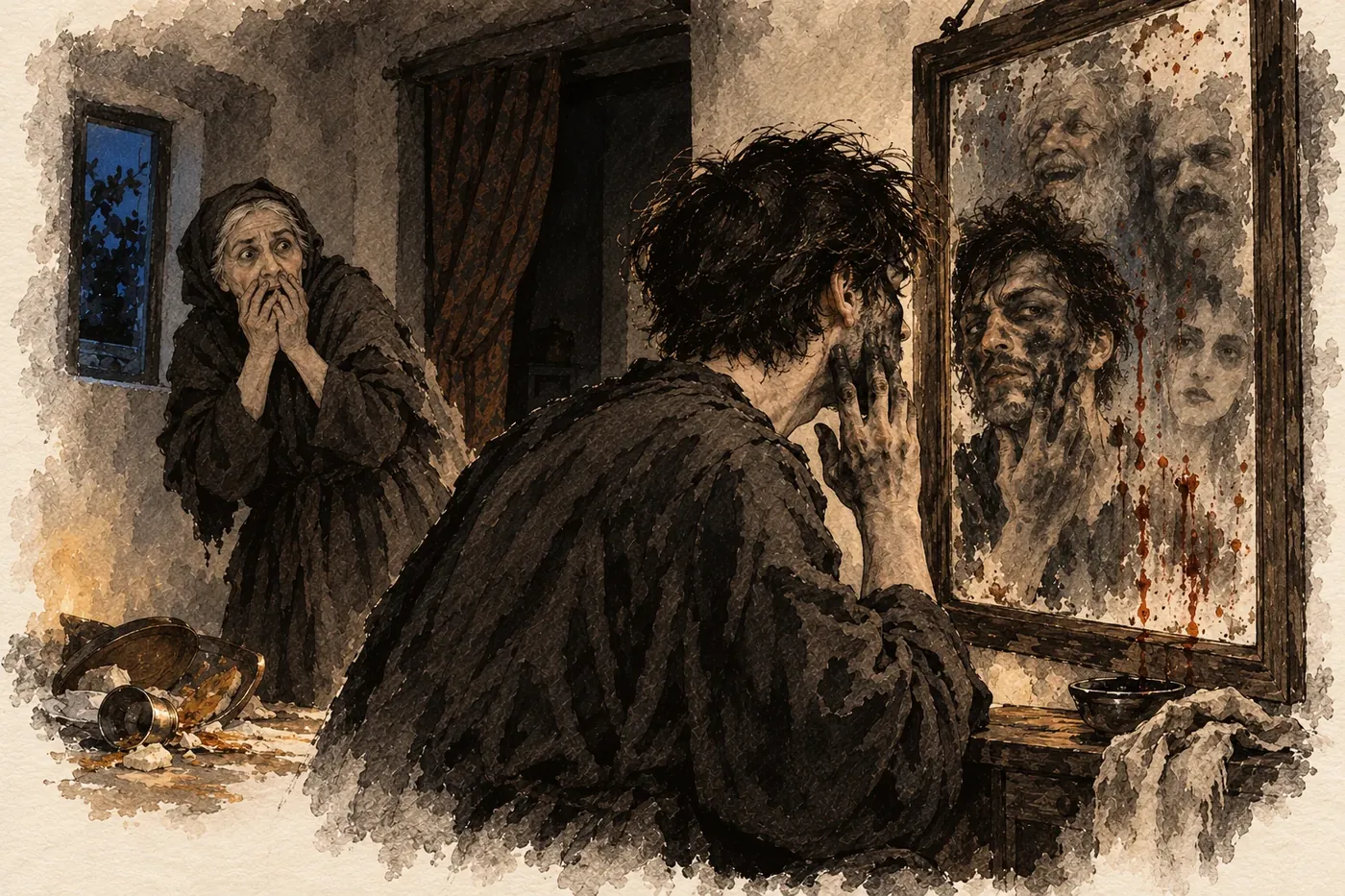
When my nurse brought me a bowl of barley soup and some chicken and rice, she screamed in fear and terror, stepped back, and dropped the supper tray. I was pleased that at least I had frightened her. Then I got up, trimmed the wick with the snuffers, went to the mirror and rubbed the soot over my face. What a frightening face! With my finger I pulled down the skin under my eye and let it go. I stretched my mouth wide, puffed out my cheeks, lifted my beard from underneath and twisted it to either side. I made faces. What ridiculous and frightening expressions my face could make! It was as if, in this way, I could see laid bare all the shapes, all the ridiculous, frightening and unbelievable forms, that were hidden deep in my nature. I recognized these expressions in myself, I felt them, and at the same time they seemed ridiculous to me. All these faces were in me, and they were mine. Frightening masks, criminal masks, laughable masks, that changed at a touch of my fingertip. The old Quran-reciter, the butcher, my wife: I saw them all in myself, as if they had been reflected in me. All these faces had been in me, but none of them was mine. Had the stuff of my face and its look not been formed by some unknown urge, by obsessions, couplings and despairs handed down to me? And I, the keeper of this inherited burden: had my mind not, through some mad and laughable instinct, set itself without my willing it to keep these expressions in my face? Perhaps only at the moment of death would my face be freed from this obsession and take on the natural look it ought to have! But even in that last state, would the expressions that my mocking will had always been carving into my face not leave their mark more firmly and more deeply? In any case, I understood what I was capable of! I discovered what I could do. Suddenly I burst out laughing.1 What a rasping, grating, frightening laugh it was! The hair on my body stood on end, because I did not recognize my own voice. It sounded in my ear like a stranger’s voice, a laugh that had often twisted at the back of my throat, that I had often heard close to my ear. Just then I started coughing, and a gob of bloody phlegm, a piece of my liver,2 landed on the mirror. I smeared it across the mirror with my fingertip. When I turned round I saw Naneh-Joon, pale as moonlight, her hair wild, her dull eyes full of terror. She was holding a bowl of barley soup, the same soup she had brought me, and staring at me blankly. I held my hands in front of my face, went behind the curtain of the back closet and hid.
Notes
- ◇ The laugh. The rasping laugh the narrator does not recognize as his own is the dry, grating laugh of the old men in the book, the laugh that makes your hair stand on end. It keeps coming back, and now it comes out of him. ↩
- a piece of my liver: in Persian the liver (jegar), more than the heart, is the seat of deep feeling and grief, so the phrase is both literal and an image of heartbreak. ↩
This scene on the loop
The lit bead is this scene; red beads are the thread you pick. Gold arcs join it to the scenes it echoes (31, 32). Pick a thread to see where that figure or object comes back; tap any bead to read that scene. The whole loop, with every thread and echo.
This scene in the Persian and literal English, line by line · the scene’s page, with who and what is in it · all scenes