 New Naqqali
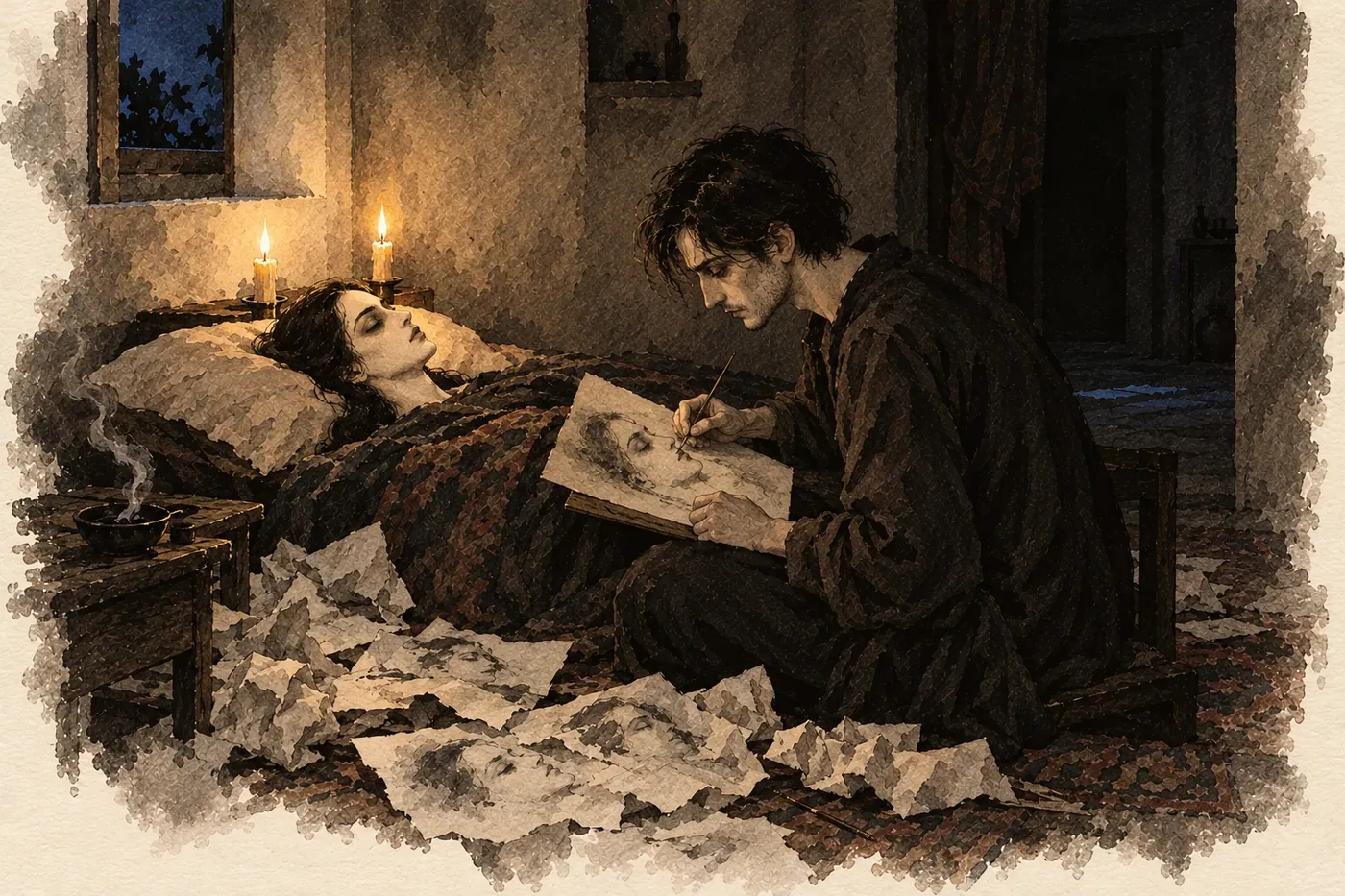
At last I put out the lamp, which was smoking, brought two candlesticks and lit them above her head. In the trembling candlelight the look of her face grew calmer, and in the half-light of the room it took on a mysterious, ethereal air. I took my paper and the tools of my work and came to the side of her bed (for now the bed was hers). I wanted to draw, at my leisure, this form that was condemned, very slowly, little by little, to decay and nothingness, this form that seemed motionless and fixed in one pose. I wanted to set down its main lines on paper, to choose the very lines of that face that had moved me.
A drawing, however slight and simple, must move you and have a soul. But I, who was used to painting pen-case covers as if they were printed, now had to set my own thought and my own imagination to work. That is, I had to call up before me the phantom of her face that had moved me: to glance at her face, then shut my eyes and put on paper the lines I chose from it, so that in this way, through my own thought, I might perhaps find an opium for my tormented soul. In the end I took refuge in the motionless life of lines and shapes.
This subject suited my dead style of painting particularly well. Painting from a corpse. In fact I was a painter of the dead. But the eyes, her closed eyes: did I need to see them again? Were they not formed clearly enough in my thoughts, in my brain?
I do not know how many times I drew her face, until almost morning! But none of them came out as I wanted. Whatever I drew, I tore up. I neither grew tired of the work, nor felt the time passing.
This scene on the loop
The lit bead is this scene; red beads are the thread you pick. Gold arcs join it to the scenes it echoes (3, 37). Pick a thread to see where that figure or object comes back; tap any bead to read that scene. The whole loop, with every thread and echo.
This scene in the Persian and literal English, line by line · the scene’s page, with who and what is in it · all scenes