 New Naqqali
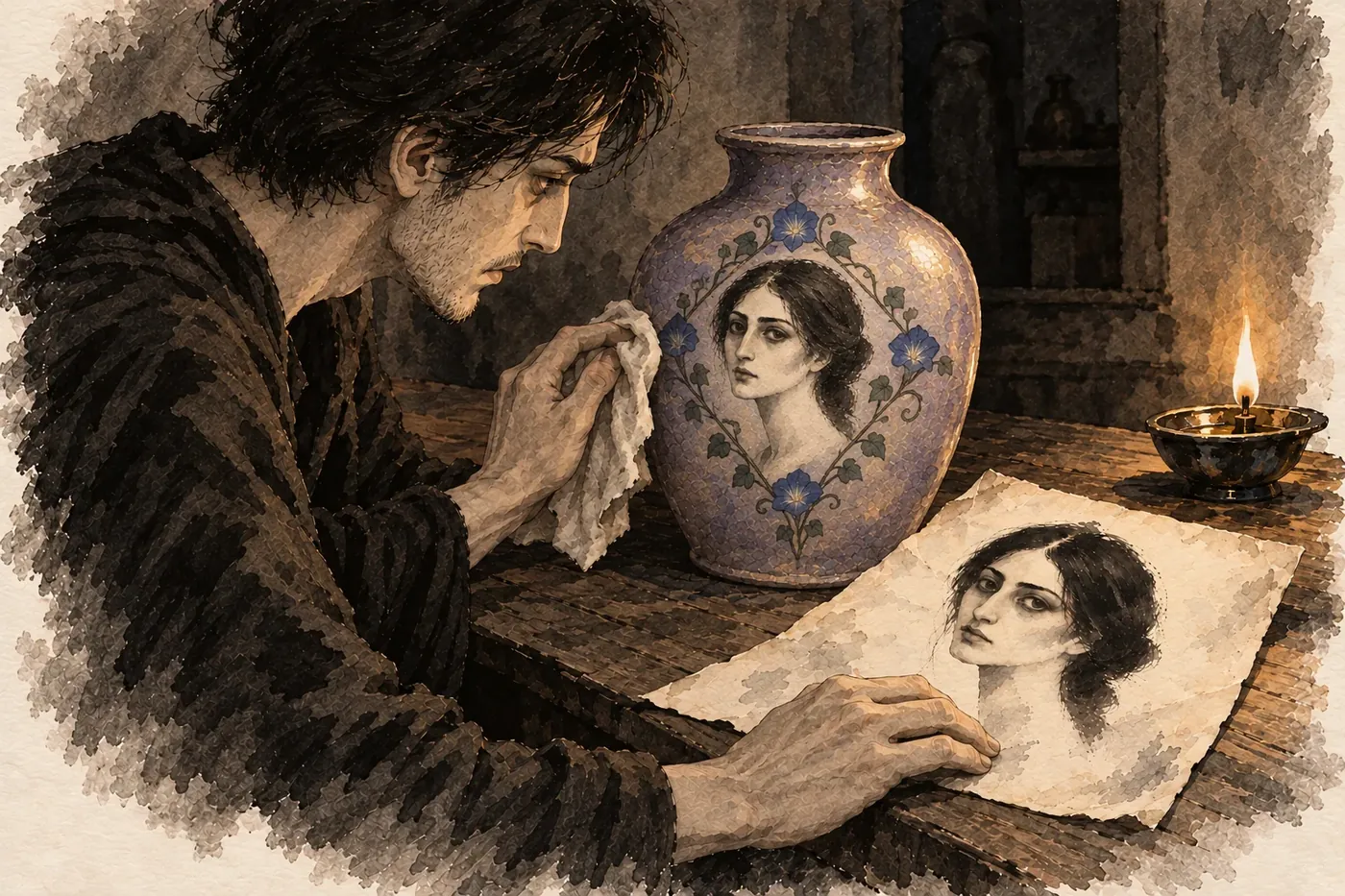
The hearse stopped. I picked up the jar and jumped down from the hearse. I was at the door of my house. I hurried into my room and put the jar on the table. I went and fetched the tin box (the same tin box that was my money box, which I had hidden in the back closet of my room) and came to the door to give the box to the old driver in place of his wages. But he had vanished. Not a trace of him or his hearse could be seen. Disappointed, I went back to my room. I lit the lamp, took the jar out of the handkerchief and wiped the dust off it with my sleeve. The jar had an old, clear, violet glaze that had turned the color of a crushed golden wasp. On one side of its body was a diamond-shaped border of blue morning glories, and inside it, inside the diamond, a face was painted: her face, the face of a woman, with large black eyes, eyes larger than ordinary eyes, accusing eyes, as if I had committed unforgivable sins without knowing it. Bewitching eyes, at once anxious and astonished, threatening and promising. These eyes frightened you and drew you in at the same time, and in their depths shone a supernatural, intoxicating glow. She had high cheekbones, a high forehead, thin eyebrows that met in the middle, full lips half open, and untidy hair, one strand of which clung to her temples.
I took out of the tin box the picture of her that I had drawn last night, and compared them. It did not differ from the painting on the jar by a single speck; they were like copies of each other. The two were one and the same, the work of one wretched pen-case painter. Perhaps the spirit of the jar’s painter had entered me while I was drawing, and my hand had passed into his control. You could not tell them apart. Only, mine was on paper, while the painting on the jar had an old, clear glaze that had given the picture a mysterious spirit, a strange, uncommon spirit, and the spark of an evil spirit shone in the depths of her eye. No, it was unbelievable! The same large, unthinking eyes, the same look, reserved and at the same time free!
This scene on the loop
The lit bead is this scene; red beads are the thread you pick. Gold arcs join it to the scenes it echoes (15, 20, 26, 27, 49). Pick a thread to see where that figure or object comes back; tap any bead to read that scene. The whole loop, with every thread and echo.
This scene in the Persian and literal English, line by line · the scene’s page, with who and what is in it · all scenes