 New Naqqali
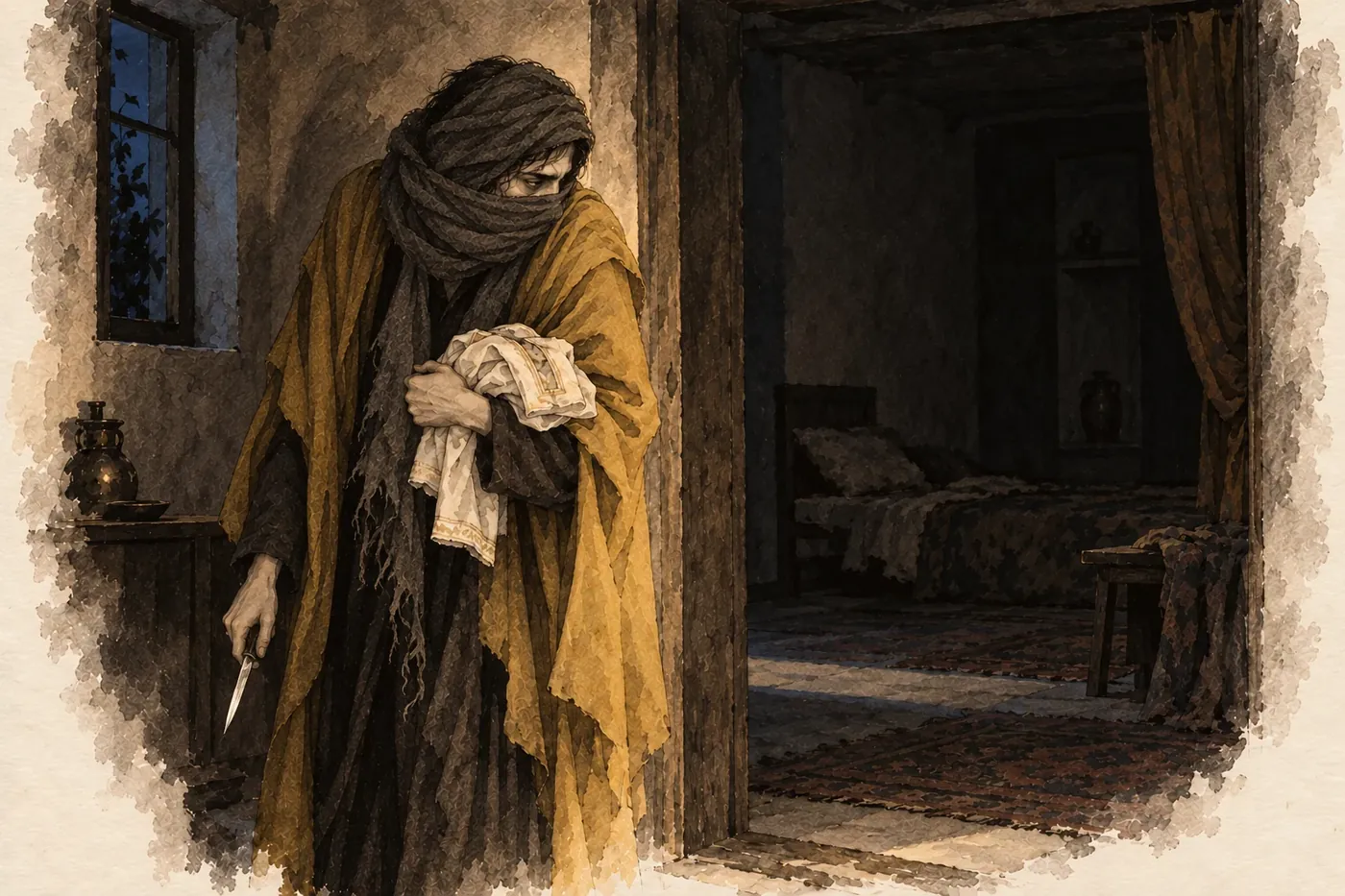
At last I too made a decision, a terrible decision. I got out of bed, rolled up my sleeve, and took the bone-handled knife that I had put under my pillow. I hunched over and threw a yellow cloak over my shoulders, then wrapped my head and face in a scarf. I felt that, at the same time, something of the spirit of the butcher and of the old junk dealer had come together in me. Then I crept on tiptoe toward my wife’s room. Her room was dark. I opened the door quietly. She seemed to be dreaming. She was saying aloud to herself: “Undo your neck-scarf!”1 I went to the side of her bed and held my head close to her warm, gentle breath. What a sweet, life-giving warmth it had! I thought that if I breathed this warmth for a while, I would come back to life. Oh! For how long I had believed that everyone’s breath must be as hot and burning as mine. I looked carefully to see whether there was another man in her room, that is, whether one of her lovers was there. But she was alone. I understood that everything I had laid at her door had been pure slander and lies. Who knows, perhaps she was still a virgin! I was ashamed of all my imaginary suspicions about her. This feeling did not last more than a minute, because just then, from outside the door, came the sound of a sneeze,2 and I heard a muffled, mocking laugh that made your hair stand on end. The sound pulled every vein in my body taut. If I had not heard that sneeze and that laugh, if that call for patience had not come, I would have done as I had decided. I would have cut all the flesh of her body into pieces and given it to the butcher in front of our house to sell to people. I myself would have given a piece of the meat of her thigh to the old Quran-reciter as a votive offering,3 and the next day I would have gone to him and said: “You know whose meat that was you ate yesterday?” If he had not laughed, I would have had to do it at night, so that my eyes would not meet the harlot’s eyes, because the look in her eyes made me ashamed. It reproached me. In the end I picked up a piece of cloth from beside her bed that had caught around my foot, and ran out in terror. I flung the knife up onto the roof, because it was this knife that had bred all these murderous thoughts in me. I got rid of the knife, which looked like the butcher’s knife. When I got back to my room, I saw by the oil lamp that I had taken her shirt, the dirty shirt that had lain against the flesh of her body: a soft silk shirt of Indian work, which smelled of her body, of mogra perfume, and in which something of her body’s movement, of her very being, remained. I smelled it, put it between my legs and went to sleep. I had never slept so peacefully on any night. Early in the morning I woke to my wife shouting and carrying on. She had started a row over the lost shirt, and kept repeating: “A brand-new shirt!” And yet its cuff was torn. But even if it had come to bloodshed, I would not have given the shirt back. Did I not have a right to one old shirt of my wife’s?
Notes
- ◇ “Undo your neck-scarf!” The nurse has already reported hearing the harlot say these words at night. Dressed as he now is, hunched, in the yellow cloak, his head and face wrapped in a scarf, the narrator has the figure of the old men of the book. ↩
- a sneeze: in Persian custom a single sneeze is called “patience” (sabr), a sign to stop and wait before doing what you meant to do. Hence “that call for patience”. ↩
- votive offering (nazri): food, very often meat, given away to the poor or the pious to fulfill a vow made to God or a saint. ↩
This scene on the loop
The lit bead is this scene; red beads are the thread you pick. Gold arcs join it to the scenes it echoes (17, 32, 71, 75). Pick a thread to see where that figure or object comes back; tap any bead to read that scene. The whole loop, with every thread and echo.
This scene in the Persian and literal English, line by line · the scene’s page, with who and what is in it · all scenes