 New Naqqali
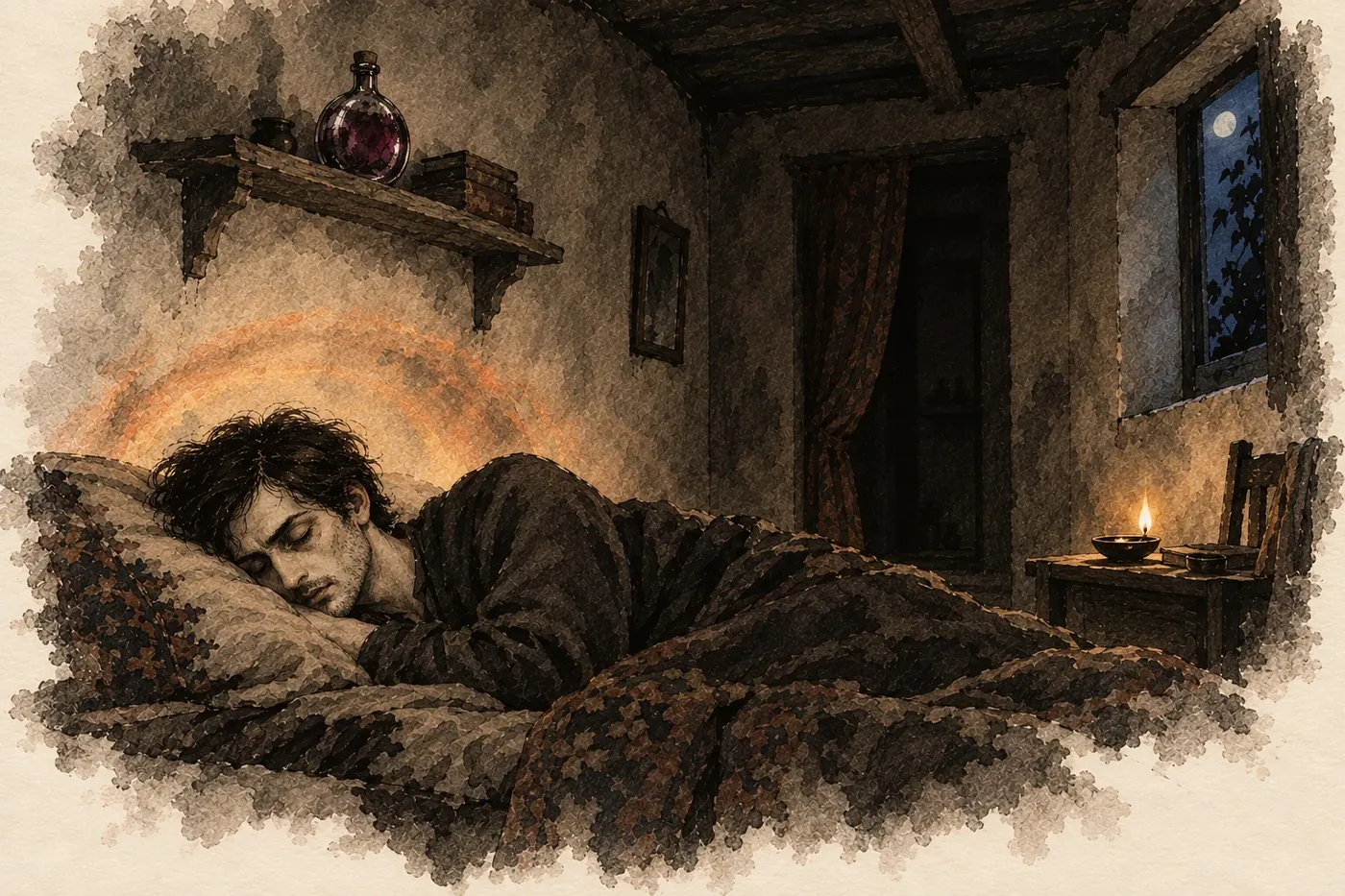
When I tried to sleep, a ring of fire pressed around my head. The sharp, sensual smell of the sandalwood oil that had been poured into the oil lamp filled my nose. It smelled of the muscles of my wife’s legs, and the taste of the stalk end of a cucumber, faintly bitter, was in my mouth. I ran my hand over my body, and in my mind I compared the parts of my body (thigh, calf, arm and all the rest) with the parts of my wife’s body. The line of her thigh and buttocks, the warmth of my wife’s body: all this took shape before me again. It was far stronger than imagining, because it had the form of a need. I felt that I wanted her body close to me. One movement, one decision would have been enough to put an end to this sensual temptation. But the ring of fire around my head grew so tight and so burning that I sank completely into a vague sea, crowded with terrifying figures.
It was still dark. I woke to the noise of a band of drunken watchmen passing down the alley. They were swearing filthily at one another and singing together: “Come, let’s go and drink our wine, let’s drink the wine of the land of Ray; if we don’t drink now, when will we?”
I remembered (no, suddenly it was revealed to me) that I had a flask of wine in the back closet of my room, wine in which the venom from the fang of a naga had been dissolved. One sip of it, and all the nightmares of life would be gone for good. But that harlot…? The word made me crave her all the more. It made her seem more alive and more ardent to me. What better could I imagine? I would give her a cup of that wine and drain another cup myself. Then we would die together, in one convulsion.
What is love? For all the rabble it is lechery, a passing looseness. The rabble’s love is to be found in the filthy songs, the obscenities and the coarse sayings they repeat, drunk or sober, such as “dipping the donkey’s hoof in the muck” and “pouring dirt on your head.”1 But my love for her was something else. It is true that I had known her from long ago: the strange slanting eyes, the small half-open mouth, the low, muffled voice. All of these were full of distant, painful memories for me, and in all of them I was searching for what I had been deprived of, something that was part of me and had been taken from me.
Had they deprived me of it forever? That was why a more frightening feeling had arisen in me. Another pleasure, which I felt as a compensation for my hopeless love, had become a kind of obsession for me. I do not know why I kept thinking of the butcher opposite the window of my room, who would roll up his sleeve, say “In the name of God,”2 and cut the meat. The way he stood and moved was always before my eyes.
Notes
- the donkey’s hoof in the muck, dirt on your head: coarse street sayings for what the rabble call love. The first is a vulgar slang phrase for sex; the second, from the old gesture of throwing dust on one’s head in mourning, means to disgrace and ruin oneself. ↩
- “In the name of God” (bismillah): the words a Muslim butcher says before he slaughters or cuts, so that the meat is lawful to eat. ↩
This scene on the loop
The lit bead is this scene; red beads are the thread you pick. Gold arcs join it to the scenes it echoes (31, 36). Pick a thread to see where that figure or object comes back; tap any bead to read that scene. The whole loop, with every thread and echo.
This scene in the Persian and literal English, line by line · the scene’s page, with who and what is in it · all scenes