 New Naqqali
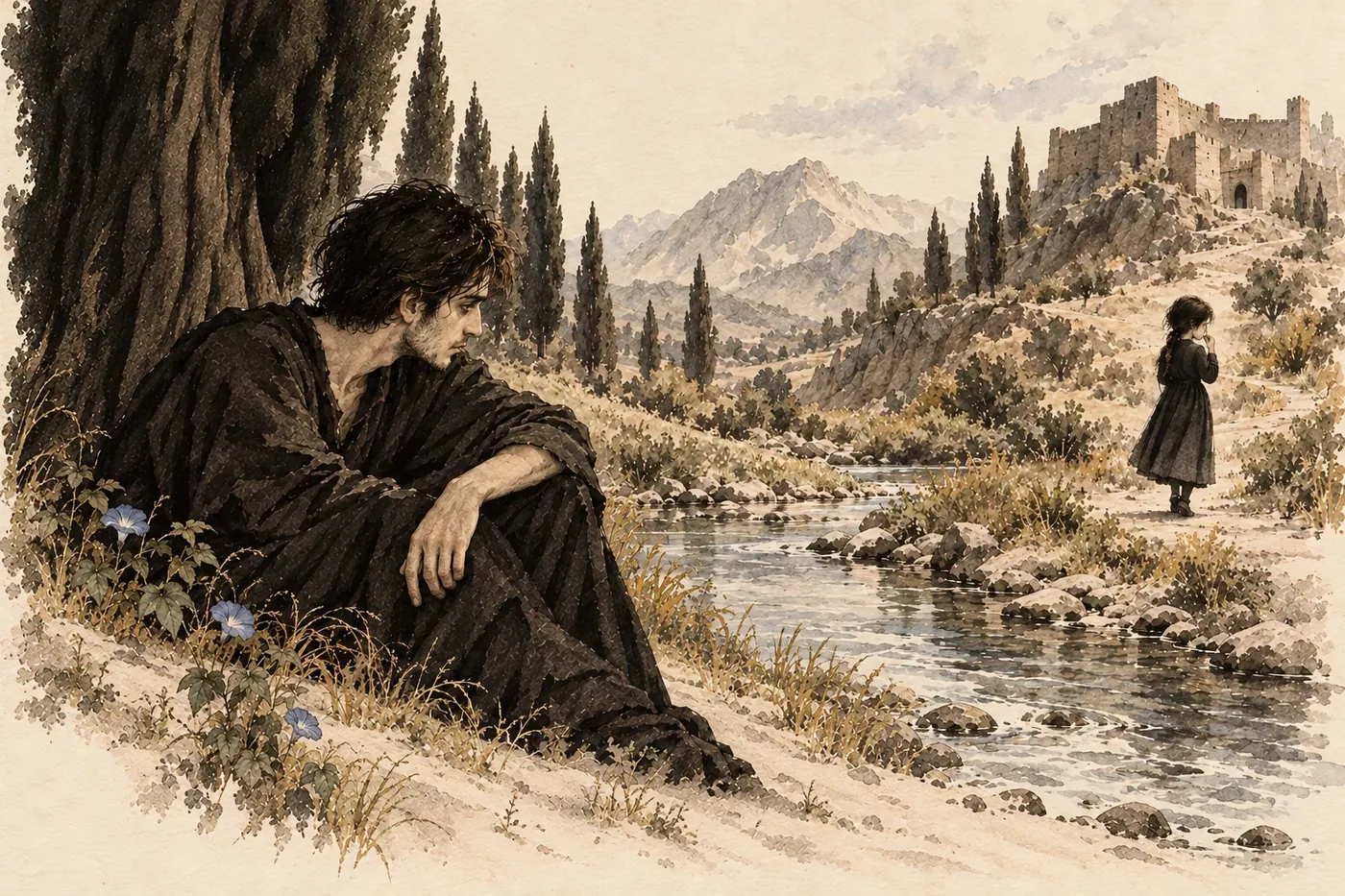
When I came near the Soren stream, a bare, dry mountain rose up before me. Its hard, dry bulk reminded me of my nurse. I do not know what connection there was between them! I went along the side of the mountain and came into a small, pleasant enclosure ringed by mountains. The ground was covered with bushes of blue morning glory,1 and on top of the mountain stood a tall fortress built of heavy mud bricks.
By then I felt tired. I went to the bank of the Soren stream and sat down on the sand in the shade of an old cypress. It was a lonely, hidden place. It seemed that no one had ever set foot there. Suddenly I noticed a little girl come out from behind the cypress trees and go toward the fortress. She wore a black dress woven very fine and light, of silk, it seemed. She was chewing the nail of her left hand,2 and she glided past with a free, careless movement. It seemed to me that I had seen her before, that I knew her. But from so far away, in the glare of the sun, I could not make out how she suddenly vanished!
I sat frozen where I was, unable to make the slightest movement. But then, all at once, I saw her with my own bodily eyes pass in front of me and vanish. Was she a real being, or an illusion? Had I been dreaming, or was I awake? I tried hard to remember, but it was no use. I felt a strange shiver run down my spine. It seemed to me that at that hour all the shadows of the fortress on the mountain had come to life, and that the little girl had been one of the people who once lived in the ancient city of Ray. All at once the scene in front of me seemed familiar. I remembered that once as a child, on Sizdah Bedar, I had come to this very place. My mother-in-law and that harlot were there too. How we ran after each other that day and played behind the cypress trees! Then a group of other children joined us; I do not remember them well. We played hide-and-seek. Once, when I was chasing this same harlot, near this same Soren stream, her foot slipped and she fell into the water. They pulled her out and took her behind a cypress to change her clothes. I followed her. They held up a prayer chador3 in front of her, but from behind the tree I secretly saw her whole body. She was smiling and chewing the forefinger of her left hand. Then they wrapped a white shawl around her and spread her black silk dress, woven of fine thread, out in the sun.
At last I lay down on the sand at the foot of the old cypress. The sound of the water came to my ears like the broken, meaningless words people murmur in their sleep. Without meaning to, I sank my hands into the warm, damp sand. I squeezed the warm, damp sand in my fist. It was like the firm flesh of a girl who has fallen into the water and whose clothes have been changed.
Notes
- ◇ The picture’s landscape. An old cypress, a stream, blue morning glories, a girl in black: the narrator has walked into the scene he always painted on his pen cases. ↩
- ◇ The left hand. The girl chews the nail of her left hand, as the nurse said his wife did even in the cradle; the old man on the pen case holds the forefinger of his left hand to his lips. The gesture keeps returning. ↩
- prayer chador (chador-namaz): a light, full-length wrap that women wear at home for prayer. Here the women hold it up as a screen. ↩
This scene on the loop
The lit bead is this scene; red beads are the thread you pick. Gold arcs join it to the scenes it echoes (5, 9, 20, 54, 66, 73). Pick a thread to see where that figure or object comes back; tap any bead to read that scene. The whole loop, with every thread and echo.
This scene in the Persian and literal English, line by line · the scene’s page, with who and what is in it · all scenes