 New Naqqali
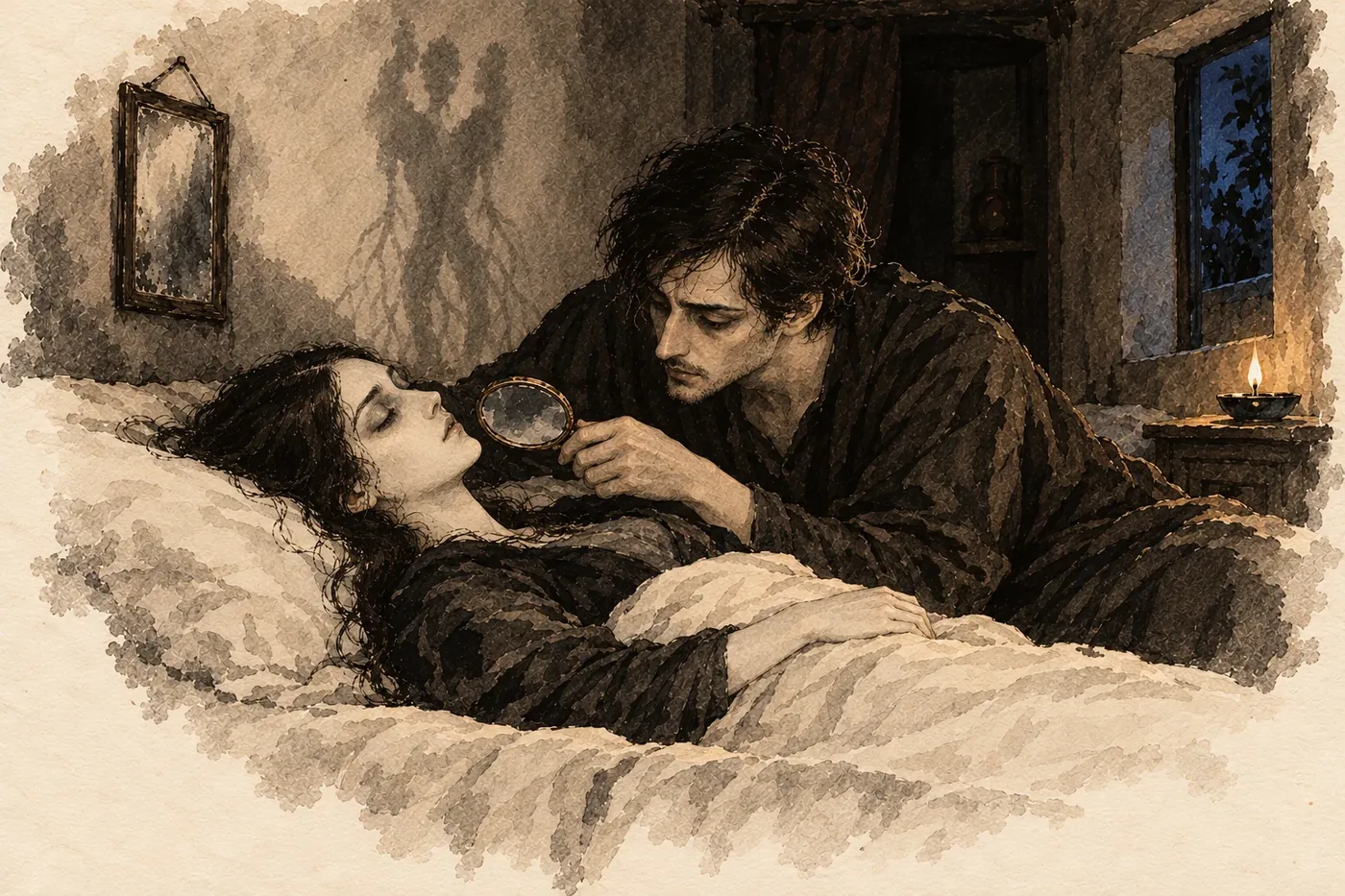
Now I could feel the warmth of her body, and smell the damp scent that rose from her heavy black hair. I do not know why I raised my trembling hand (my hand was not under my control) and ran it over her hair, over that lock of hair that always clung to her temples. Then I pushed my fingers into her hair. Her hair was cold and damp. Cold, completely cold, as if she had been dead for several days. I had not been mistaken: she was dead. I slipped my hand in at the neck of her dress and laid it on her breast and her heart. There was not the slightest beat. I brought the mirror and held it in front of her nose, but there was not the slightest sign of life in her.
I wanted to warm her with the heat of my own body, to give her my warmth and take the cold of death from her. Perhaps in this way I could breathe my own soul into her body. I took off my clothes, got onto the bed and lay down beside her. We clung together like the male and female mandrake. In fact her body was like the body of a female mandrake torn from its male, and it had the same burning love of the mandrake. Her mouth tasted sharp and bitter, like the stalk end of a cucumber.1 Her whole body had gone as cold as hail. I felt the blood freezing in my arteries, and this cold going through to the bottom of my heart. All my efforts were useless. I got down from the bed and put my clothes on. No, it was not a lie. She had come here, into my room, into my bed, and given her body up to me. She had given me both her body and her soul!
While she was alive, while her eyes were full of life, only the memory of her eyes had tormented me. But now, without feeling, without movement, cold, with her eyes closed, she had come and given herself up to me. With her eyes closed!
This was the very one who had poisoned my whole life. Or perhaps my life was made to be poisoned, and I could have had no other life than a poisoned one. Now, here in my room, she gave me her body and her shadow. Her fragile, passing soul, which had no bond with the world of earthly beings, slowly came out through her pleated black dress, out of the body that had tormented her, and went into the world of wandering shadows. It seemed to take my shadow with it too. But her body lay there without feeling or movement. Her soft, slack muscles, her veins and sinews and her bones were waiting to rot, and a tasty meal had been laid out for the worms and the mice under the ground. In this poor room, full of misery and wretchedness, in a room like a grave, in the darkness of the eternal night that had closed around me and sunk into the very walls, I had to spend a long, dark, cold, endless night beside a corpse. Beside her corpse. It seemed to me that for as long as the world has been the world, for as long as I have existed, a corpse, a cold corpse without feeling or movement, has been with me in the dark room.
Notes
- the stalk end of a cucumber: the end by the stem, which tastes sharp and bitter; Persians cut it off before eating. ↩
This scene on the loop
The lit bead is this scene; red beads are the thread you pick. Gold arcs join it to the scenes it echoes (9, 46, 75). Pick a thread to see where that figure or object comes back; tap any bead to read that scene. The whole loop, with every thread and echo.
This scene in the Persian and literal English, line by line · the scene’s page, with who and what is in it · all scenes