 New Naqqali
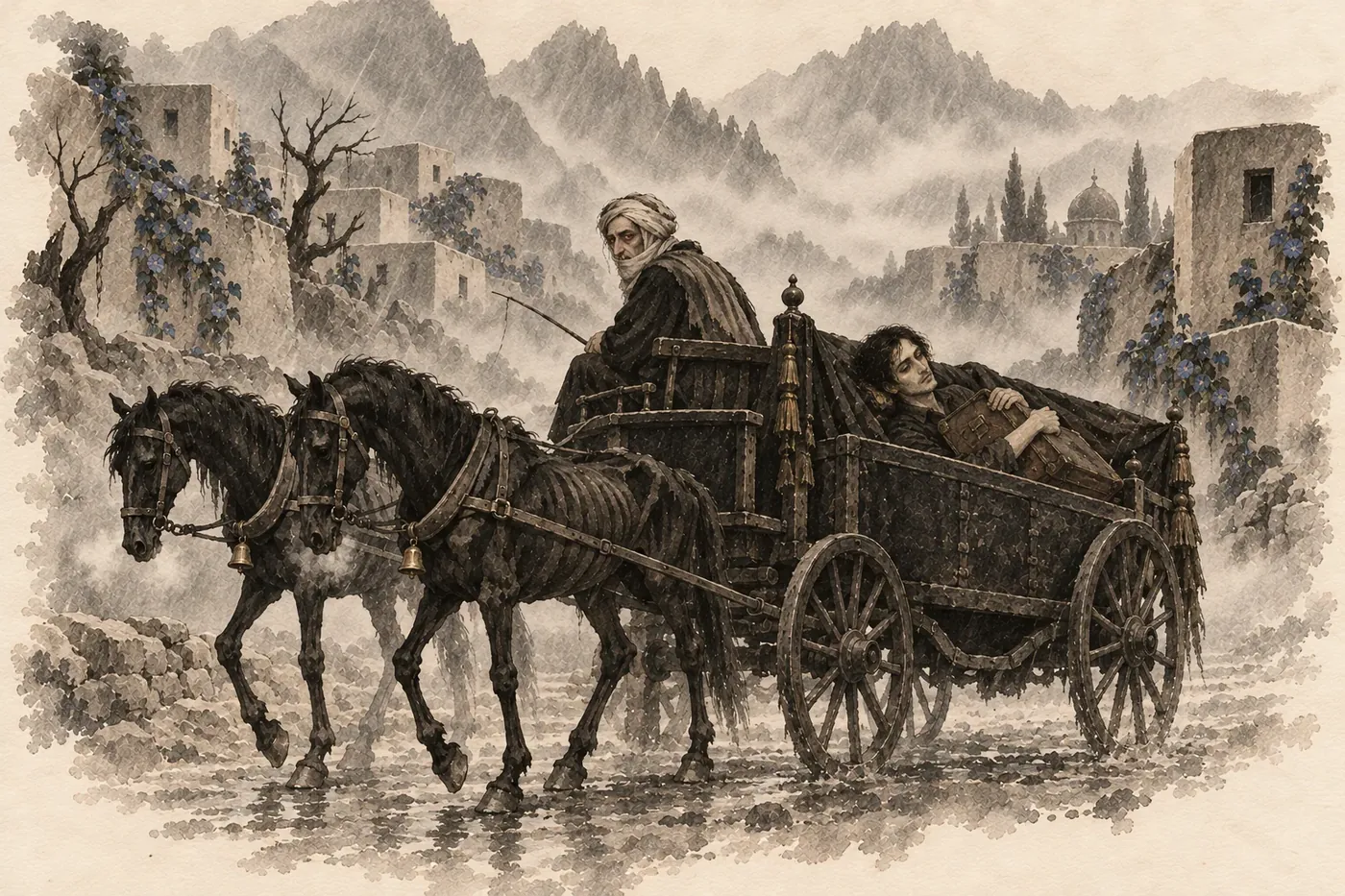
He got up from where he sat. I went back to my house, went into my room, and with great effort dragged the suitcase with the dead woman in it as far as the door. At the door I saw an old, broken-down hearse, harnessed to two lean black horses, so thin they looked like anatomical specimens. The hunchbacked old man sat up on the driver’s seat with a long whip in his hand, but he did not once turn round to look at me. With great effort I put the suitcase inside the hearse, which had a special space in the middle for a coffin. I climbed in too and lay down in the coffin space, resting my head on its edge so that I could see around me. Then I slid the suitcase onto my chest and held it tight with both hands.
The whip cracked in the air. The horses set off, panting. The steam of their breath streamed from their nostrils like pipes of smoke in the rainy air, and they moved in long, gentle strides. Their thin forelegs, like the hands of a thief whose fingers have been cut off by law and plunged into hot oil,1 came down on the ground slowly, in long steps, without a sound. The bells on their necks rang out in the damp air with a rhythm all their own. A kind of comfort, without cause and beyond words, had taken hold of me from head to foot, so that for all the motion of the hearse I did not feel the slightest jolt. I felt only the weight of the suitcase on my ribs.
Her dead body, her corpse: it was as if this weight had always been pressing on my chest. Thick mist had closed in around the road. The hearse passed over mountains, plains and rivers with a peculiar speed and ease. Around me lay a new landscape, like no other, that I had never seen, asleep or awake.
On both sides of the road rose jagged mountains and strange, beaten-down, cursed-looking trees, and between them stood gray houses shaped like triangles, cubes and prisms, with low, dark windows without glass. These windows looked like the dazed eyes of someone in a delirious fever. I do not know what the walls held in them that sent cold and chill right into a person’s heart. It was as if no living being could ever have lived in these houses! Perhaps these houses had been built for the shadows of ethereal beings!
It seemed the driver was taking me by a road of his own, or by no road at all. In some places only cut-off stumps and crooked, twisted trees lined the road, and behind them stood low and tall houses in geometric shapes, cones (truncated cones), with narrow, crooked windows, from which blue morning glories had pushed out and were climbing over the doors and walls. Then all at once this landscape vanished behind the thick mist. Heavy clouds, swollen with rain, gripped the mountain peaks and pressed down on them, and a fine drizzle hung scattered in the air like dust, drifting and aimless. After we had gone on for a long time, the hearse stopped near a high, barren mountain. I slid the suitcase off my chest and got up. Behind the mountain lay a lonely, quiet, pleasant enclosure. I had never seen the place and did not know it, and yet it seemed familiar to me, as if it were not beyond my imagining. The ground was covered with plants of scentless blue morning glory. It seemed that no one had ever set foot there. I put the suitcase down on the ground, and the old driver turned round and said: “This is Shah Abdolazim. You won’t find a better place than this for you. Not a bird flaps a wing here, eh…”
Notes
- a thief’s hands: under the old Islamic penal law a thief’s fingers could be cut off, and the stump was plunged into hot oil to seal the wound. ↩
This scene on the loop
The lit bead is this scene; red beads are the thread you pick. Gold arcs join it to the scenes it echoes (24, 31, 44, 55, 58). Pick a thread to see where that figure or object comes back; tap any bead to read that scene. The whole loop, with every thread and echo.
This scene in the Persian and literal English, line by line · the scene’s page, with who and what is in it · all scenes