 New Naqqali
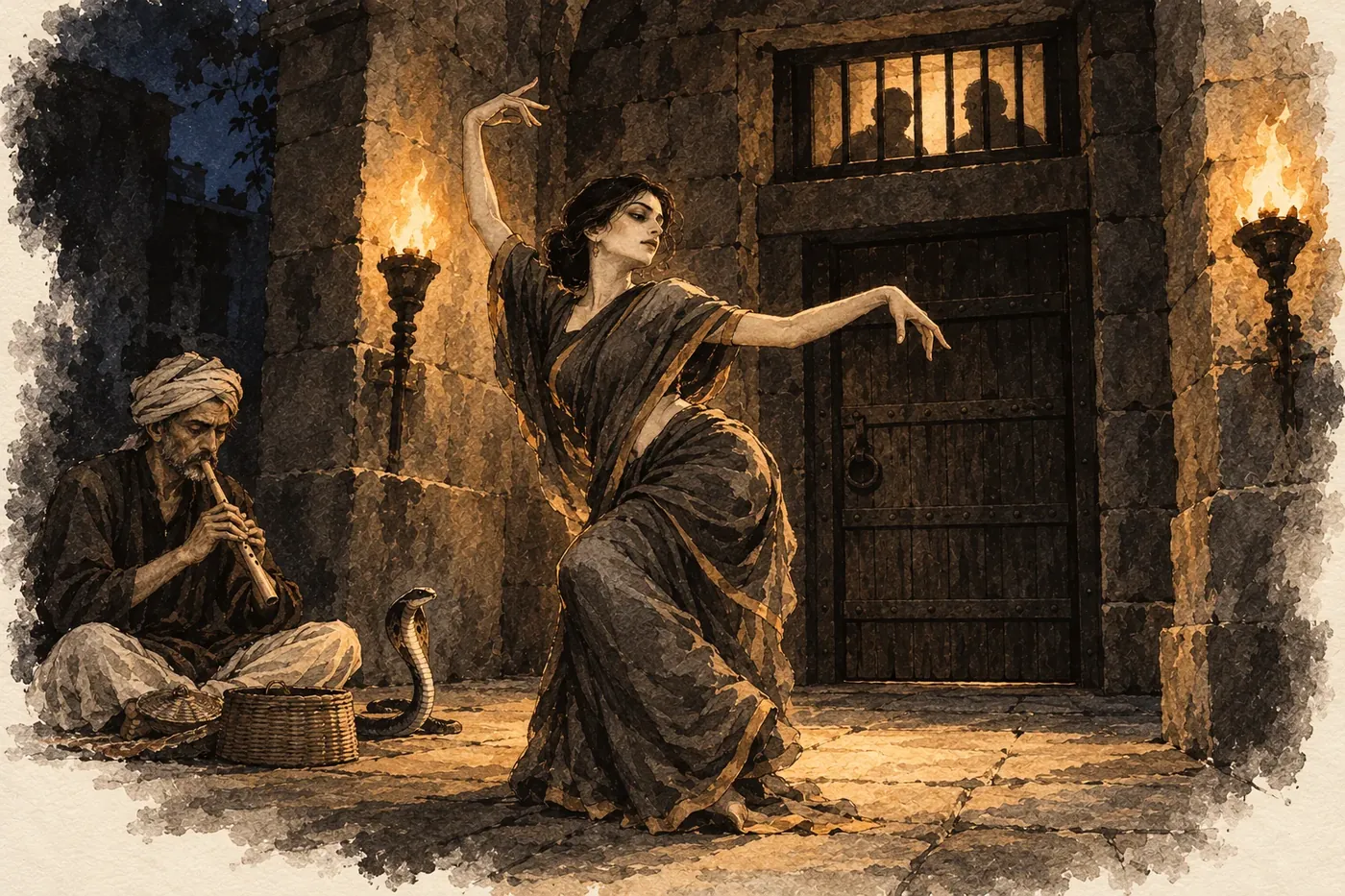
I had only just been born when my uncle comes back from his travels to Benares. But it seems his taste in love matched my father’s too: he falls in love with my mother, not with one heart but with a hundred, and in the end he deceives her, for his likeness to my father, outward and inward, makes this easy. As soon as the affair comes out, my mother says she will leave them both, unless my father and my uncle go through the ordeal of the cobra;1 and whichever of them stays alive, she will belong to him. The ordeal was this: my father and my uncle were to be thrown into a dark room, like a dungeon, with a cobra. Whichever of them the snake bit would naturally cry out; then the snake charmer would open the door of the room and save the other, and the Bugam-Dasi would belong to him.
Before they are thrown into the dungeon, my father asks the Bugam-Dasi to dance before him once more, to dance the sacred dance of the temple. She agrees. To the snake charmer’s reed pipe, in the light of the torch, she dances with meaningful, measured, gliding movements, and twists and writhes like a cobra. Then they throw my father and my uncle into a special room with the cobra. Instead of a cry of terror, there rises a moan mixed with a sickening laugh, a mad cry.2 They open the door, and my uncle comes out of the room. But his face is old and broken, and his hair… From the force of his fear and dread, from the sound of the angry snake sliding and hissing (the snake with round, fiery eyes and poisoned fangs, whose body was a long neck ending in a swelling like the bowl of a small spoon), from the force of his terror, my uncle comes out of the room with white hair. By the terms of the bargain, the Bugam-Dasi becomes my uncle’s. A terrible thing! No one knows whether the one who survived the ordeal was my father or my uncle. For the ordeal had unsettled his mind: he had completely forgotten his former life, and did not recognize the child. So they assumed it was my uncle.
Is not this whole legend bound up with my life? Or has the echo of that sickening laugh, the terror of that ordeal, not left its mark on me? Is it not bound up with me?
Notes
- cobra: Hedayat’s word is mar-e nag, from the Indian naga, the cobra, whose neck spreads into a hood when it rears to strike. ↩
- ◇ The laugh. The sickening laugh from the cobra room recalls the dry, hair-raising laugh of the old man in the first part of the book; and a man who comes out white-haired, when no one can say which brother he is, is one more double. ↩
This scene on the loop
The lit bead is this scene; red beads are the thread you pick. Gold arcs join it to the scenes it echoes (5, 34, 50, 76). Pick a thread to see where that figure or object comes back; tap any bead to read that scene. The whole loop, with every thread and echo.
This scene in the Persian and literal English, line by line · the scene’s page, with who and what is in it · all scenes