 New Naqqali
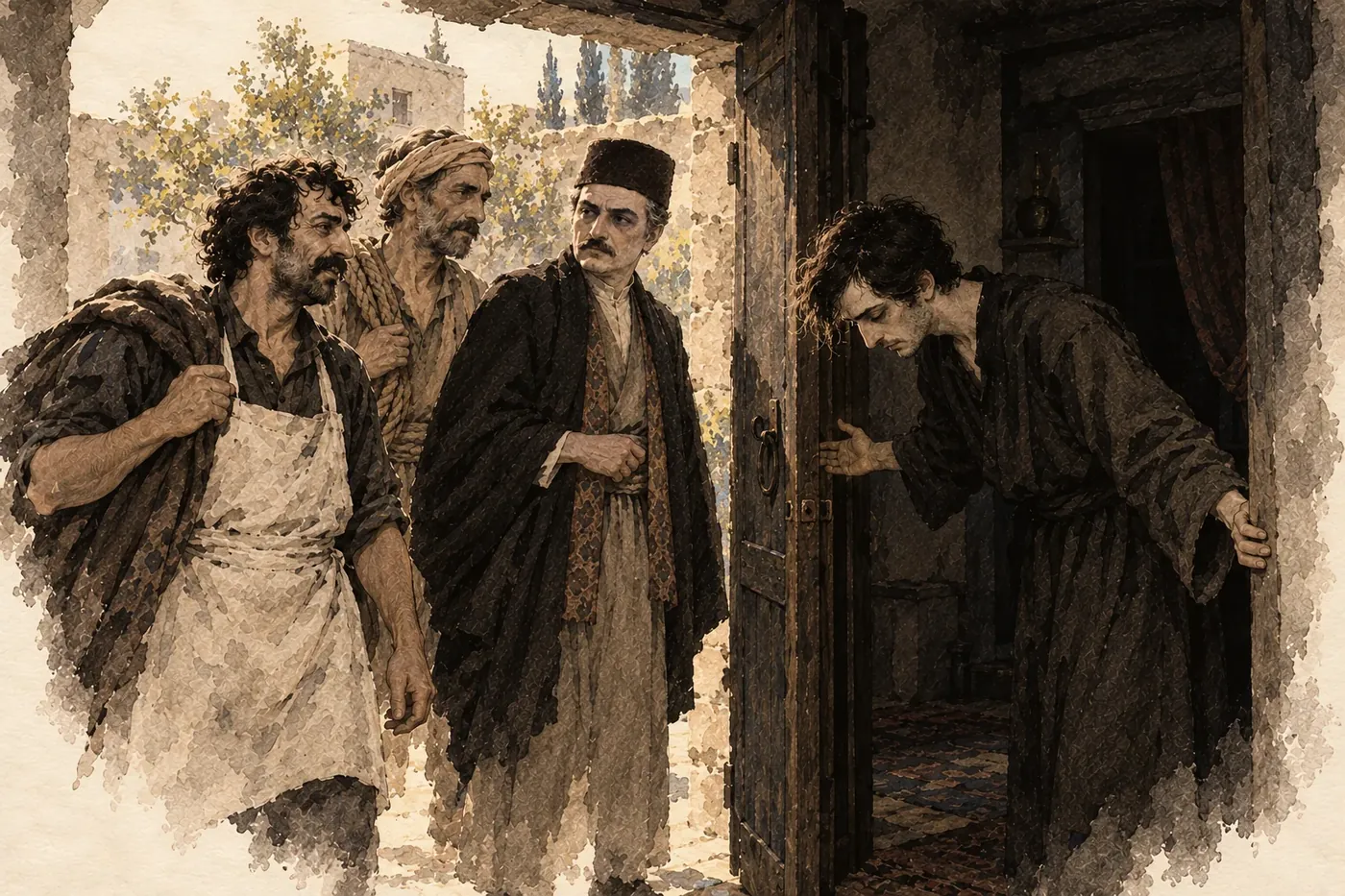
At night, when I came home, she had not come in yet. I did not know whether she had come in or not! I did not want to know at all. For I was condemned to loneliness, condemned to death. I wanted, by any means at all, to get in touch with her lovers. This, nobody will believe. Anyone I had heard she liked, I lay in wait for. I would go and swallow a thousand kinds of humiliation and disgrace. I would get to know that man, flatter him, talk him round, and bring him to her. And what lovers they were: a tripe seller, a jurist, a liver seller, the police chief, a well digger, a merchant, a philosopher. Their names and titles were different, but they were all apprentices of the sheep’s-head cook.1 She preferred every one of them to me.
With what humiliation and shame I made myself small and wretched! Nobody will believe it. I was afraid my wife would slip out of my hands. I wanted to learn from my wife’s lovers how to behave, how to be, how to charm; but I was a wretched pimp, and all the fools laughed in my face. How could I ever have learned the manners and ways of the rabble, anyway? Now I know that she loved them because they were shameless, stupid and stinking. Her love was bound up with filth and death. Did I really want to sleep with her? Was it her looks that had bewitched me, or her loathing of me? Or was it her movements and her ways, or the love I had felt for her mother since childhood? Or had all of these joined hands? No, I do not know. I know only one thing: this woman, this harlot, this witch, had poured I do not know what poison into my soul, into my being, so that I did not only want her: every particle of my body needed the particles of her body, and cried out that it needed them. I longed fiercely to be with her on some lost island where no human being existed. I wished that an earthquake, or a storm, or a thunderbolt from heaven would blast all this rabble that breathed and ran about and enjoyed itself behind the wall of my room, blast them all, so that only she and I were left. Even then, would she not have preferred any other creature to me, an Indian snake or a dragon? I wished I could spend one night with her, and that we would die together in each other’s arms. It seems to me that this would have been the highest end of my existence and my life. It was as if this harlot took delight and pleasure in my torment, as if the pain that was eating me away were not enough.
In the end I could no longer work or move, and stayed shut up at home, like a walking corpse. Nobody knew the secret between us. My old nurse, who had become the companion of my slow death, scolded me. Because of this same harlot, I heard people around me, behind my back, whispering to each other: “How does this poor woman put up with this mad husband?” They were right, for the depths to which I had sunk were beyond belief.
Notes
- apprentices of the sheep’s-head cook: a Persian saying for men all cut from the same cloth. The kalleh-paz boils sheep’s heads and feet and sells them before dawn, one of the humblest trades of the bazaar. ↩
This scene on the loop
The lit bead is this scene; red beads are the thread you pick. Pick a thread to see where that figure or object comes back; tap any bead to read that scene. The whole loop, with every thread and echo.
This scene in the Persian and literal English, line by line · the scene’s page, with who and what is in it · all scenes