 New Naqqali
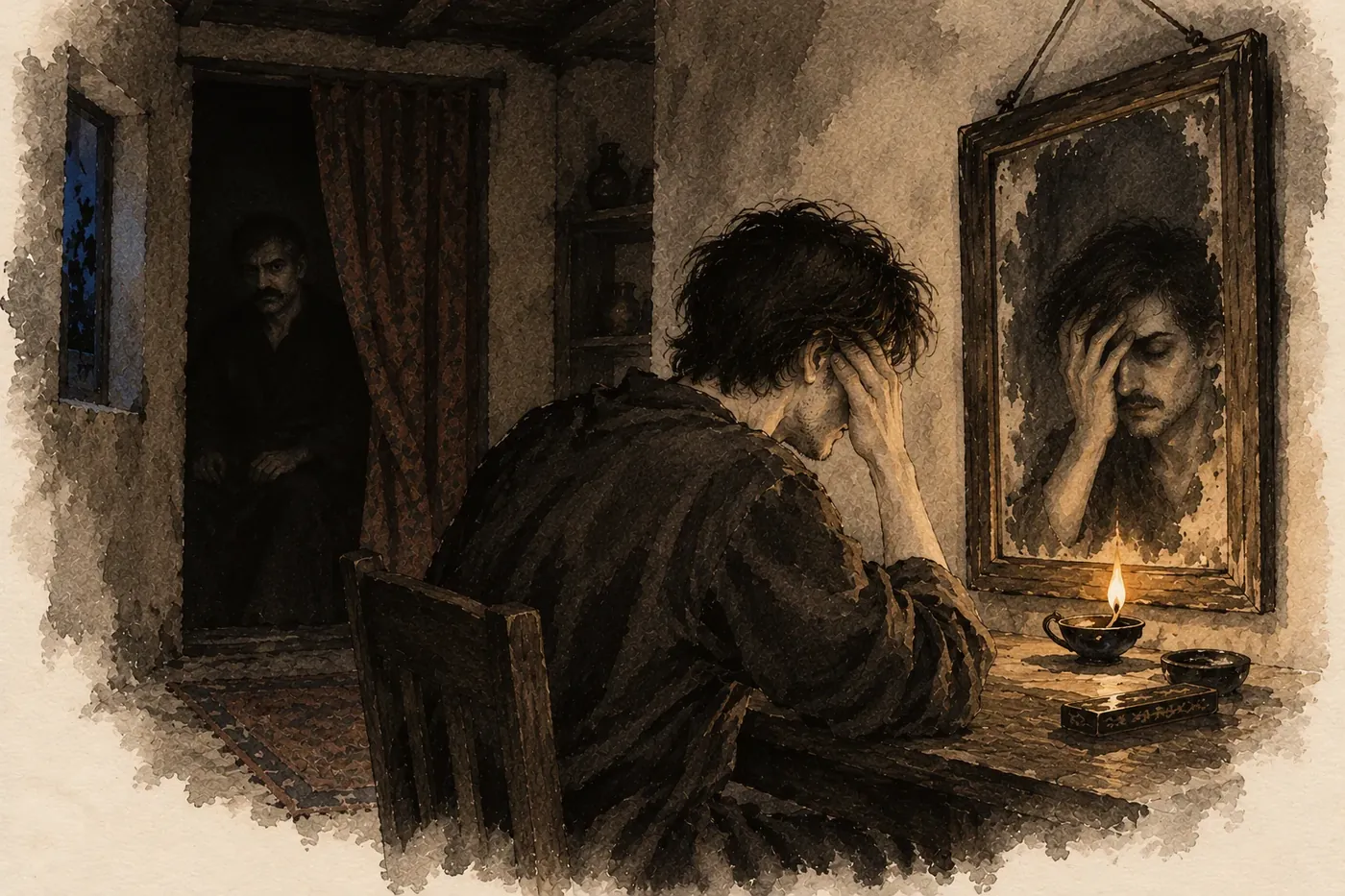
Once more silence and darkness covered everything. I did not light the oil lamp in my room; I liked sitting in the dark. Darkness, this thick, flowing substance that seeps into every place and everything: I had grown used to it. It was in the dark that lost thoughts, forgotten fears, terrible, unbelievable thoughts that had been hiding in some corner of my brain, I did not know where: all of them came to life again, began to move, and made faces at me. The corner of the room, behind the curtain, beside the door: all were full of these thoughts, these shapeless, threatening forms. There, beside the curtain, sat a frightening figure. It did not move. It was neither sad nor glad. Every time I turned, it was looking straight into my eyes. I knew his face. It was as if I had seen this same face in my childhood. It was a Sizdah Bedar day, beside the Soren stream. I was playing hide-and-seek with the other children, and this same face had shown itself to me among other, ordinary faces, small, comical and harmless. His face was like the butcher’s,1 the butcher across from the window of my room. It seemed this person had had a hand in my life, and that I had seen him often! It seemed this shadow was my double, and lived within the narrow circle of my life...
As soon as I got up to light the oil lamp, that figure, too, faded and vanished of its own accord. I went to the mirror and looked closely at my face. The image that took shape there seemed foreign to me. It was unbelievable and frightening. My reflection had become stronger than I was, and I had become like the image in the mirror. I felt that I could not stay alone with myself in one room. I was afraid that if I ran away, he would come after me, like two cats facing each other for a fight. But I raised my hand and held it in front of my eyes, to make an eternal night in the hollow of my palm. Often terror held a special pleasure and drunkenness for me, so that my head spun, my knees went weak and I wanted to vomit. Suddenly I noticed that I was standing on my feet. This seemed strange to me, a miracle. How could I be standing on my feet? It seemed to me that if I moved one of my feet I would lose my balance. A kind of dizziness had come over me. The earth and its creatures had drawn endlessly far away from me. Vaguely I wished for an earthquake, or a thunderbolt from the sky, so that I could be born again into a calm, bright world.
When I was about to go to bed, I said to myself several times, “Death... death...” My lips were closed, yet I was frightened by the sound of my own voice. All my old courage had left me. I had become like the flies2 that swarm into the room at the start of autumn, dried-up, lifeless flies that are afraid of the buzzing of their own wings. For a while they huddle, motionless, in a corner of the wall. As soon as they realize they are alive, they hurl themselves blindly against the door and the walls, and their dead bodies drop all around the room.
Notes
- ◇ The double. A face from the Soren stream that is like the butcher’s: the narrator’s doubles (his shadow, the old men, the butcher) keep drawing closer to one another. ↩
- ◇ The autumn flies. The flies that crept into the room in autumn first appeared in a single line about the nurse’s fear of death. Now the narrator likens himself to them. ↩
This scene on the loop
The lit bead is this scene; red beads are the thread you pick. Gold arcs join it to the scenes it echoes (31, 45). Pick a thread to see where that figure or object comes back; tap any bead to read that scene. The whole loop, with every thread and echo.
This scene in the Persian and literal English, line by line · the scene’s page, with who and what is in it · all scenes