 New Naqqali
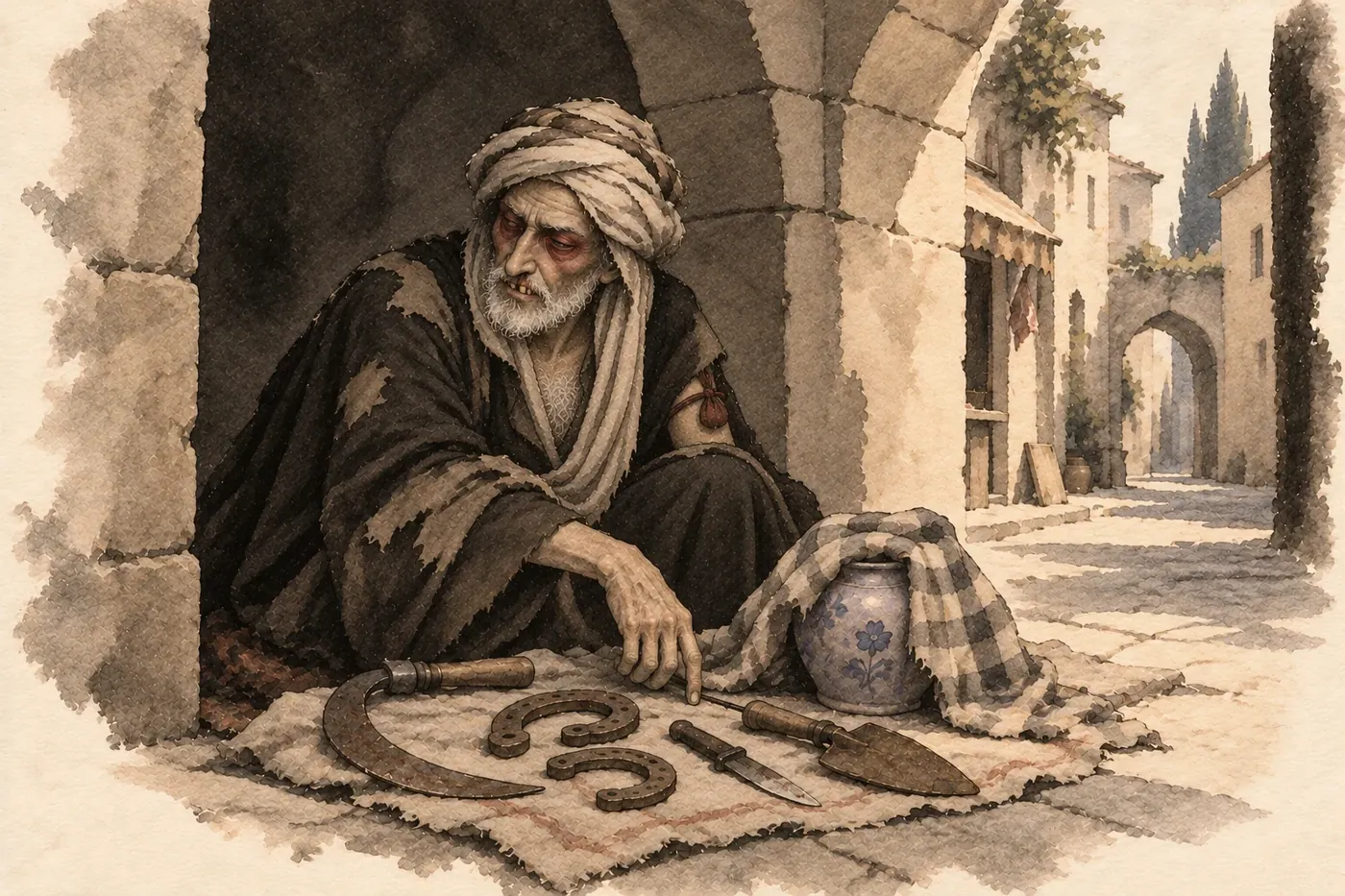
A little farther on, under an arch, sits a strange old man with his wares spread out in front of him. On his cloth lie a hand sickle, two horseshoes, a few kinds of colored beads, a knife, a mousetrap, a rusty pair of pincers, an inkwell filler, a comb with broken teeth, a small spade, and a glazed jar over which he has thrown a checked handkerchief.1 For hours, for days, for months I have watched him from behind the window. Always in a dirty scarf and a cloak of Shushtar cloth, with his collar open and the white hair of his chest sticking out of it, with inflamed eyelids that some stubborn, shameless disease is eating away, and an amulet tied to his arm, he sits in the same position. Only on Thursday nights2 does he recite the Quran, through his yellow teeth, half of them gone. It seems this is how he earns his bread, for I have never seen anyone buy anything from him. It is as if this man’s face has often been in the nightmares I have had. Behind that shaven head of his, brown as a gallnut, with a turban the color of milk and sugar wound round it, behind his low forehead, what stubborn, stupid thoughts have sprung up like weeds? It seems the cloth in front of the old man, and his spread of junk, have some special bond with his life. Several times I made up my mind to go and talk to him, or to buy something from his wares, but I did not dare.
My nurse told me that in his youth this man had been a potter, and had kept only this one jar for himself, and that now he earned his bread by selling odds and ends.
Notes
- ◇ A jar under a cloth. A glazed jar covered with a handkerchief: compare the Ragha jar the old hearse driver wrapped in his dirty handkerchief. The old man’s scarf, inflamed eyelids and bare, hairy chest belong to the face that keeps returning. ↩
- Thursday nights: the eve of Friday, the Muslim holy day, when the Quran is recited for the dead, often by poor old reciters paid a coin or a little food. ↩
This scene on the loop
The lit bead is this scene; red beads are the thread you pick. Gold arcs join it to the scenes it echoes (4, 18, 23, 48, 62, 63, 64, 65, 68, 70, 76). Pick a thread to see where that figure or object comes back; tap any bead to read that scene. The whole loop, with every thread and echo.
This scene in the Persian and literal English, line by line · the scene’s page, with who and what is in it · all scenes